


An English Commercial Court judgment, handed down eleven years after the incident, traces a shipboard explosion and fire to a packaging failure under the IMDG Code — and to a decade-long jurisdictional battle that followed it.
An English Commercial Court judgment has ordered an Indian chemical manufacturer — referred to here as the Defendant — to pay Maersk over US$13.3 million in damages, costs, and indemnities arising from a 2015 explosion and fire aboard the container ship Maersk Seoul. Handed down on 28 July 2026, the judgment is the first detailed public account of the incident, and sets out in unusual depth how a calcium hypochlorite packaging failure escalated into a major casualty and, ultimately, an eleven-year legal dispute spanning three jurisdictions.
The Facts
- Vessel: Maersk Seoul — a fully cellular, gearless container vessel built in 2006, 332 m in length, 42.2 m in breadth, with 9 cargo holds and capacity for 8,411 TEU.
- Date and time of incident: 19 July 2015, approximately 1333 hrs local time.
- Location: The Strait of Hormuz, roughly nine hours after the vessel departed Jebel Ali, UAE at 0442 hrs, bound for Jeddah.
- Cargo shipped: Five containers of calcium hypochlorite shipped by the Defendant in July 2015 — two containers of granules packed in plastic drums, and three containers of galets (large tablets), individually foil-wrapped and packed in fibreboard cartons.
- Containers loaded on Maersk Seoul: Three of the five — galet/fibreboard containers MSKU7134795 and MSKU2820576, and drum container MSKU4266606 — were loaded on 18 July 2015, having first transited via the feeder vessel Talassa.
- Cause: The explosion and fire were caused by violent decomposition of the cargo in containers MSKU7134795 and/or MSKU2820576.
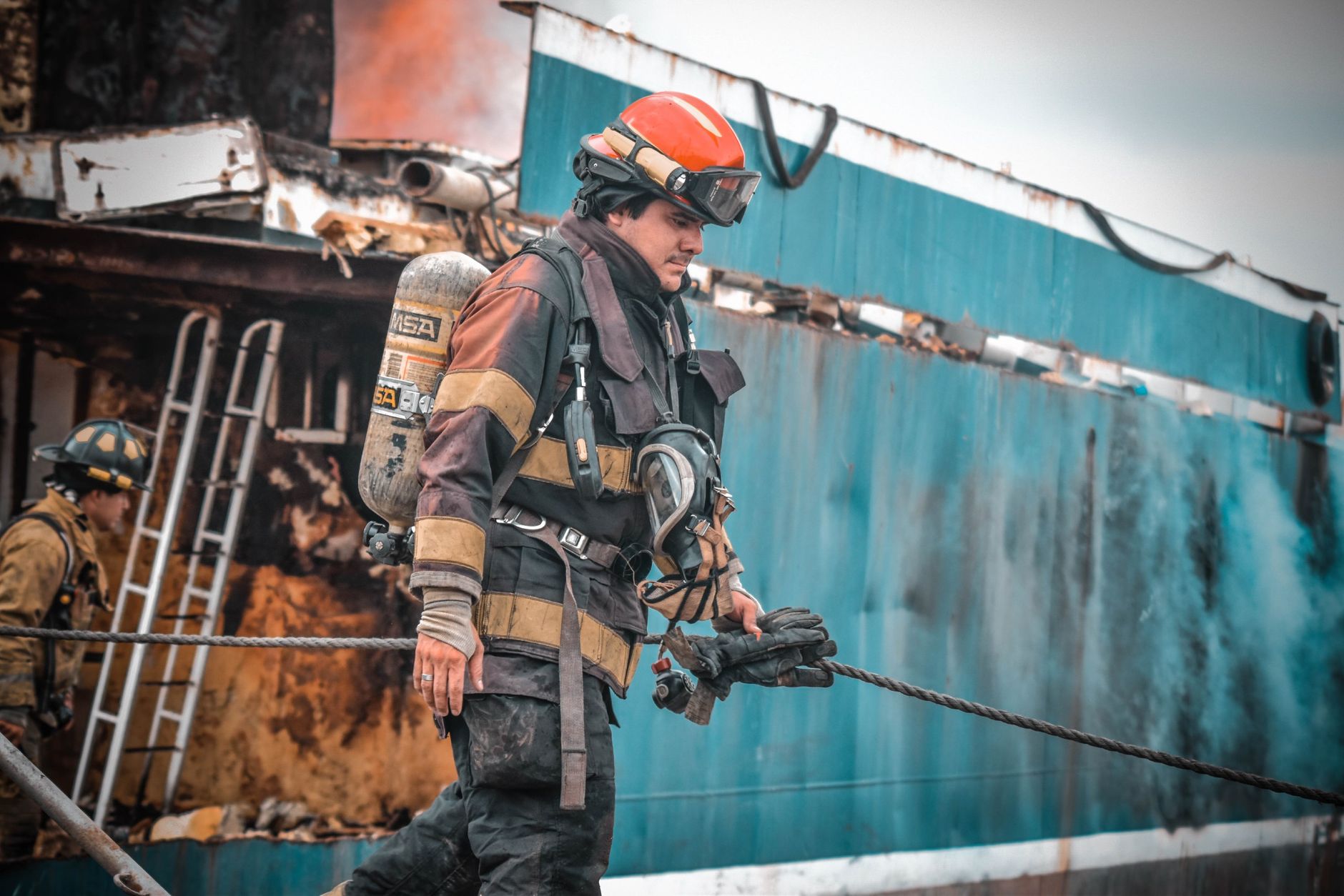
- Damage: A major fire broke out on deck above cargo hold no. 1. Firefighting involved CO₂ release and boundary cooling, with assistance from the Royal Omani Navy; salvage was engaged under Lloyd’s Open Form; the fire was not fully extinguished until 23 July. Firefighting water flooded cargo holds 1 and 2 (14.2 m and 2.7 m respectively), submerging containers stowed there. Multiple containers were destroyed or damaged, and the vessel’s deck plating and electrical systems suffered heat and fire damage.
- Secondary incident: Two further containers — galet/fibreboard container MSKU4287300 and drum container MRKU9908482 — were shipped separately on the vessel Maersk Indus and discharged at Jebel Ali on 22 July as a precaution, then cross-stuffed into reefer containers (MSKU4287300 into reefer MWCU694271514). On 23 July, before the reefer’s doors were closed, MSKU4287300’s contents violently decomposed and caught fire, destroying the container and its cargo; MRKU9908482 showed heat damage during the cross-stuffing operation.
- Case: Maersk A/S v Sree Rayalaseema Hi-Strength Hypo Limited (MV “Maersk Seoul”) [2026] EWHC 2005 (Comm), Case No. CL-2021-000375, High Court of Justice, Business and Property Courts, Commercial Court, London. Before Peter MacDonald Eggers KC (sitting as a Deputy Judge). Trial: 17–18 March 2026. Judgment: 28 July 2026. Maersk represented by Tom Bird (instructed by Schjodt LLP); the Defendant did not appear and was not represented.
- Damages awarded: US$13,178,280.51 for losses arising from the explosion and fire, plus a further US$168,064.48 and £16,296 for breach of the exclusive English jurisdiction clause, plus a permanent mandatory anti-suit injunction.
Background
The Defendant is a publicly listed Indian chemical manufacturer based in Kurnool, Andhra Pradesh, with a trading relationship with Maersk spanning more than two decades for the export of calcium hypochlorite. The five containers shipped in July 2015 were carried under contracts incorporating Maersk’s standard “Safmarine” terms, which included an English law and exclusive jurisdiction clause.
Unusually, the cargo in three of the containers was packed as galets in fibreboard cartons — a special production run for an overseas customer — rather than in the plastic drums the Defendant normally used. The court heard evidence that the Defendant’s plant had operated for over two decades without a fire or explosion involving the drum-packed product, but that no thermal stability testing representative of a full container load (a proper SADT — self-accelerating decomposition temperature — test) had been carried out on the galet/fibreboard format; the test relied on had been run on a sample of only 15 mg.
The case took over a decade to resolve. Maersk issued proceedings in June 2021, but service on the Defendant under the Hague Service Convention was delayed for years, completing only in January 2024. The Defendant subsequently pursued a prolonged campaign of parallel litigation before courts in Kurnool, India, and the Andhra Pradesh High Court between 2023 and 2026, seeking to block Maersk’s London claim — including allegations of coercion, duress, and bias against the English court. Maersk obtained interim anti-suit injunctions from the English court in November 2023 and February 2024; the Defendant briefly complied and withdrew its Indian suit, before resuming similar proceedings in 2024–2026. The Defendant never filed a defence in the English proceedings and did not attend the March 2026 trial, which proceeded in its absence on the strength of Maersk’s documentary and witness evidence.
The Court’s Observations
The court accepted the expert evidence of fire and explosion specialist Mark Phillips, instructed by Maersk, that both the explosion aboard Maersk Seoul and the later shore fire at Jebel Ali resulted from the violent, self-accelerating decomposition of calcium hypochlorite — a well-documented hazard of the chemical when heat generated by decomposition cannot dissipate.
Central to the court’s reasoning was the manner in which the galets had been packed. The applicable IMDG Code entry for the cargo (UN 3487) requires that packages within cargo transport units allow for adequate air circulation throughout the cargo. The court found that the fibreboard cartons had been stuffed into the containers as a dense “block stow,” with no meaningful space between cartons to permit air circulation or heat dissipation other than at the outer edges of the stack. This was held to be a significant causal factor, and the judge accepted that, on the balance of probabilities, the incident would likely have been avoided had the cargo been packaged and stowed to allow proper airflow.
The court gave particular weight to the second, independent decomposition event at Jebel Ali. A further container of the same product — discharged purely as a precaution, with no link to any condition on board Maersk Seoul — itself violently decomposed and caught fire days later. This reinforced the conclusion that the underlying cause lay in the packaging and preparation of the cargo before shipment, rather than in stowage conditions specific to the vessel.
On this basis, the court found the Defendant in breach of (i) its contractual warranty that the goods were packed adequately for the risks of carriage and in compliance with applicable regulations, including the IMDG Code; (ii) its warranty that the goods would not cause loss or damage to the carrier or other cargo; and (iii) its common law duty to take reasonable care in preparing cargo for sea transport. Separately, the court held that the Defendant’s pursuit of multiple proceedings in India, despite the exclusive English jurisdiction clause and existing anti-suit injunctions, amounted to a continuing breach of contract.
The Court’s Verdict
Judgment was entered for Maersk on all issues. The court awarded Maersk US$13,178,280.51 in damages and indemnity for losses arising from the explosion and fire — covering settlement payments to the vessel’s registered owners, salvage costs, cargo claim settlements, and related expenses — together with a further US$168,064.48 and £16,296 for the Defendant’s breach of the exclusive jurisdiction clause, a declaration of entitlement to indemnity for any further related costs, and a permanent mandatory injunction requiring the Defendant to discontinue its Indian proceedings.
The judgment stands as the first substantial public record of the Maersk Seoul incident, and a detailed judicial account of how a packaging failure with a well-known hazardous chemical — insufficient air circulation in a densely stowed block of cartons — can escalate into a major shipboard casualty and, ultimately, a decade-long international legal dispute.
BAILII: https://www.bailii.org/ew/cases/EWHC/Comm/2026/2005.html
Discover more from IMDG Code Compliance Centre
Subscribe to get the latest posts sent to your email.