


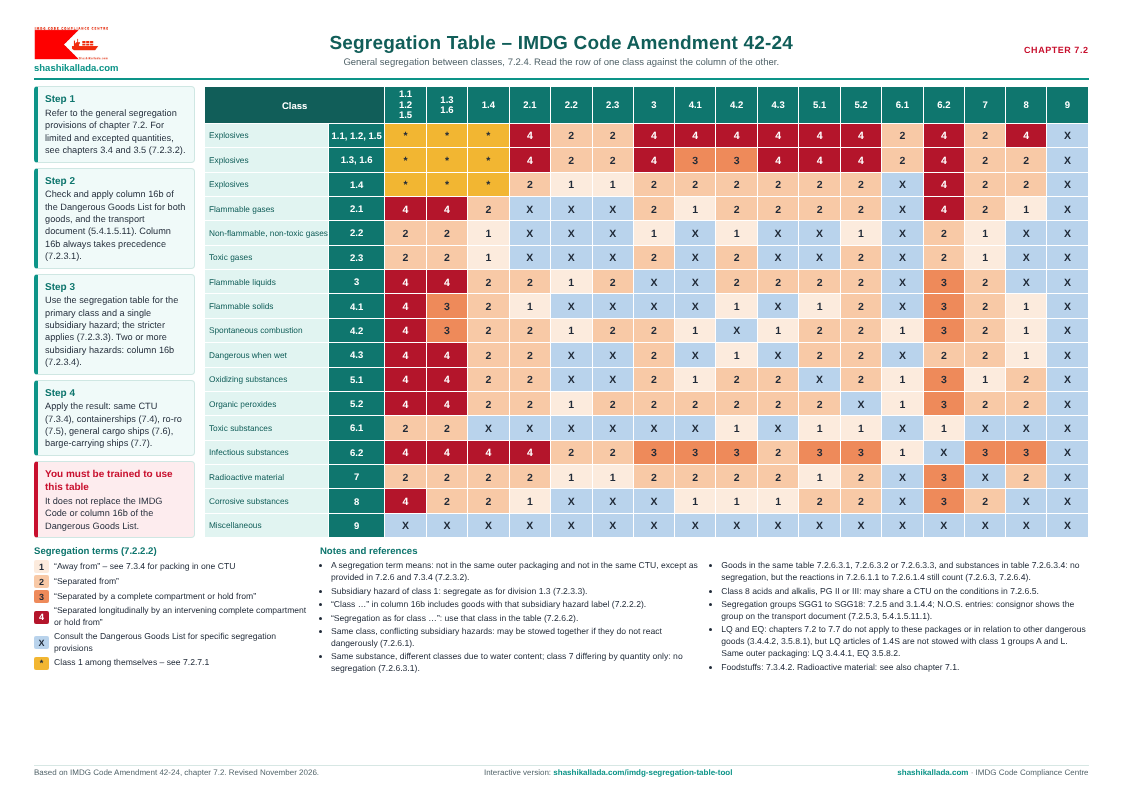
Segregation keeps mutually incompatible dangerous goods apart, so that a leak, a spill or a fire in one package does not start a dangerous reaction in another or make a fire worse. Chapter 7.2 holds the general provisions. Chapters 7.3 to 7.7 turn the result into distances and bulkheads: inside a cargo transport unit, and on container ships, ro-ro ships, general cargo ships and barge-carrying ships.
The four segregation terms (7.2.2.2)
- 1 “Away from”
- 2 “Separated from”
- 3 “Separated by a complete compartment or hold from”
- 4 “Separated longitudinally by an intervening complete compartment or hold from”
- X The Dangerous Goods List has to be consulted to verify whether there are specific segregation provisions
- * See 7.2.7.1 for segregation between goods of class 1
The segregation table (7.2.4)
| Class | 1.1 1.2 1.5 | 1.3 1.6 | 1.4 | 2.1 | 2.2 | 2.3 | 3 | 4.1 | 4.2 | 4.3 | 5.1 | 5.2 | 6.1 | 6.2 | 7 | 8 | 9 |
|---|---|---|---|---|---|---|---|---|---|---|---|---|---|---|---|---|---|
| 1.1, 1.2, 1.5 | * | * | * | 4 | 2 | 2 | 4 | 4 | 4 | 4 | 4 | 4 | 2 | 4 | 2 | 4 | X |
| 1.3, 1.6 | * | * | * | 4 | 2 | 2 | 4 | 3 | 3 | 4 | 4 | 4 | 2 | 4 | 2 | 2 | X |
| 1.4 | * | * | * | 2 | 1 | 1 | 2 | 2 | 2 | 2 | 2 | 2 | X | 4 | 2 | 2 | X |
| 2.1 | 4 | 4 | 2 | X | X | X | 2 | 1 | 2 | 2 | 2 | 2 | X | 4 | 2 | 1 | X |
| 2.2 | 2 | 2 | 1 | X | X | X | 1 | X | 1 | X | X | 1 | X | 2 | 1 | X | X |
| 2.3 | 2 | 2 | 1 | X | X | X | 2 | X | 2 | X | X | 2 | X | 2 | 1 | X | X |
| 3 | 4 | 4 | 2 | 2 | 1 | 2 | X | X | 2 | 2 | 2 | 2 | X | 3 | 2 | X | X |
| 4.1 | 4 | 3 | 2 | 1 | X | X | X | X | 1 | X | 1 | 2 | X | 3 | 2 | 1 | X |
| 4.2 | 4 | 3 | 2 | 2 | 1 | 2 | 2 | 1 | X | 1 | 2 | 2 | 1 | 3 | 2 | 1 | X |
| 4.3 | 4 | 4 | 2 | 2 | X | X | 2 | X | 1 | X | 2 | 2 | X | 2 | 2 | 1 | X |
| 5.1 | 4 | 4 | 2 | 2 | X | X | 2 | 1 | 2 | 2 | X | 2 | 1 | 3 | 1 | 2 | X |
| 5.2 | 4 | 4 | 2 | 2 | 1 | 2 | 2 | 2 | 2 | 2 | 2 | X | 1 | 3 | 2 | 2 | X |
| 6.1 | 2 | 2 | X | X | X | X | X | X | 1 | X | 1 | 1 | X | 1 | X | X | X |
| 6.2 | 4 | 4 | 4 | 4 | 2 | 2 | 3 | 3 | 3 | 2 | 3 | 3 | 1 | X | 3 | 3 | X |
| 7 | 2 | 2 | 2 | 2 | 1 | 1 | 2 | 2 | 2 | 2 | 1 | 2 | X | 3 | X | 2 | X |
| 8 | 4 | 2 | 2 | 1 | X | X | X | 1 | 1 | 1 | 2 | 2 | X | 3 | 2 | X | X |
| 9 | X | X | X | X | X | X | X | X | X | X | X | X | X | X | X | X | X |

Download the segregation table (PDF, A4 landscape) with the steps, terms and Code references on one page.
Use the primary class and the subsidiary hazard. Where there is a single subsidiary hazard, its segregation applies where it is more stringent than that of the primary hazard (7.2.3.3). Where an entry has two or more subsidiary hazards, column 16b says which segregation applies (7.2.3.4).
The order of checks
- Column 16b of the Dangerous Goods List for both entries: SG codes and the segregation group code (SGG). In case of conflict, column 16b always takes precedence (7.2.3.1).
- The table, for the primary class and the subsidiary hazard.
- Segregation groups (7.2.5). For an N.O.S. entry not listed in 3.1.4.4, the consignor decides whether the goods belong to a group and shows it on the transport document (7.2.5.3, 5.4.1.5.11.1). See Should Shippers Provide Segregation Group Name to Carrier?
- Exceptions in 7.2.6, for example the same substance in different classes because of water content, and acids and alkalis of class 8 (7.2.6.5). For limited and excepted quantities, see chapters 3.4 and 3.5 (7.2.3.2): segregation does not apply to these packages or in relation to other dangerous goods, except that division 1.4S limited quantity articles are not stowed with class 1 compatibility groups A and L (3.4.4.2, 3.5.8.1).
- Apply the result to the operation: within one cargo transport unit (7.3.4), container ships (7.4), ro-ro ships (7.5), general cargo ships (7.6), barge-carrying ships (7.7).
Example: motor spirit and sodium nitrate
UN 1203 MOTOR SPIRIT or GASOLINE or PETROL, 3, II, and UN 1498 SODIUM NITRATE, 5.1, III. Column 16b shows no entry for either, so the table decides. It gives 2, “separated from”. Whenever a segregation term applies, the goods may not be packed in the same outer packaging or transported in the same cargo transport unit, except as provided in 7.2.6 and 7.3.4 (7.2.3.2). So the two go in separate containers, and the ship planner places those containers according to 7.4.3 for “separated from”.
Who is responsible for what
| Party | Segregation duty | Code |
|---|---|---|
| Shipper (consignor) | Classifies correctly, declares the subsidiary hazard, and states the segregation group for an N.O.S. entry where it applies. A wrong classification makes every later segregation check wrong. | 5.4.1.4, 5.4.1.5.11.1, 7.2.5.3 |
| Freight forwarder | May guide the shipper in preparing the declaration, but does not sign it. Passes the declared information to the carrier unchanged. | 5.4.1.6.1 |
| Packer of the container, including the LCL consolidator | Does not pack goods that must be segregated in the same unit. Signs the container/vehicle packing certificate, which certifies this. | 7.3.4.1, 5.4.2.1 |
| Carrier and ship planner | Segregates the units on board according to the ship type, and shows the dangerous goods and their location in the stowage plan or manifest. | 7.4 to 7.7, 5.4.3.1 |
| Competent authority | Approves “away from” goods in the same container. | 7.3.4.1 |
| Terminal and port | Keeps incompatible goods apart while stored in the port area, under the IMO recommendations for port areas and local port rules. | Port rules |
Consolidators carry the most exposure here: they put different shippers’ goods in one box and sign the certificate. See To the LCL Operator: This Is What You’re Actually Signing Up For When You Mix Dangerous Goods.
Check it on this site
- IMDG Code 42-24 Segregation Table: pick two classes and get the term, with the notes on column 16b, exceptions and limited quantities.
- Segregation Tool for Container Ships: turns the term into container placement on board, for ships with closed cargo holds (7.4.3.2) and hatchless ships (7.4.3.3).
- What Is the Difference between Stowage and Segregation
Discover more from IMDG Code Compliance Centre
Subscribe to get the latest posts sent to your email.