


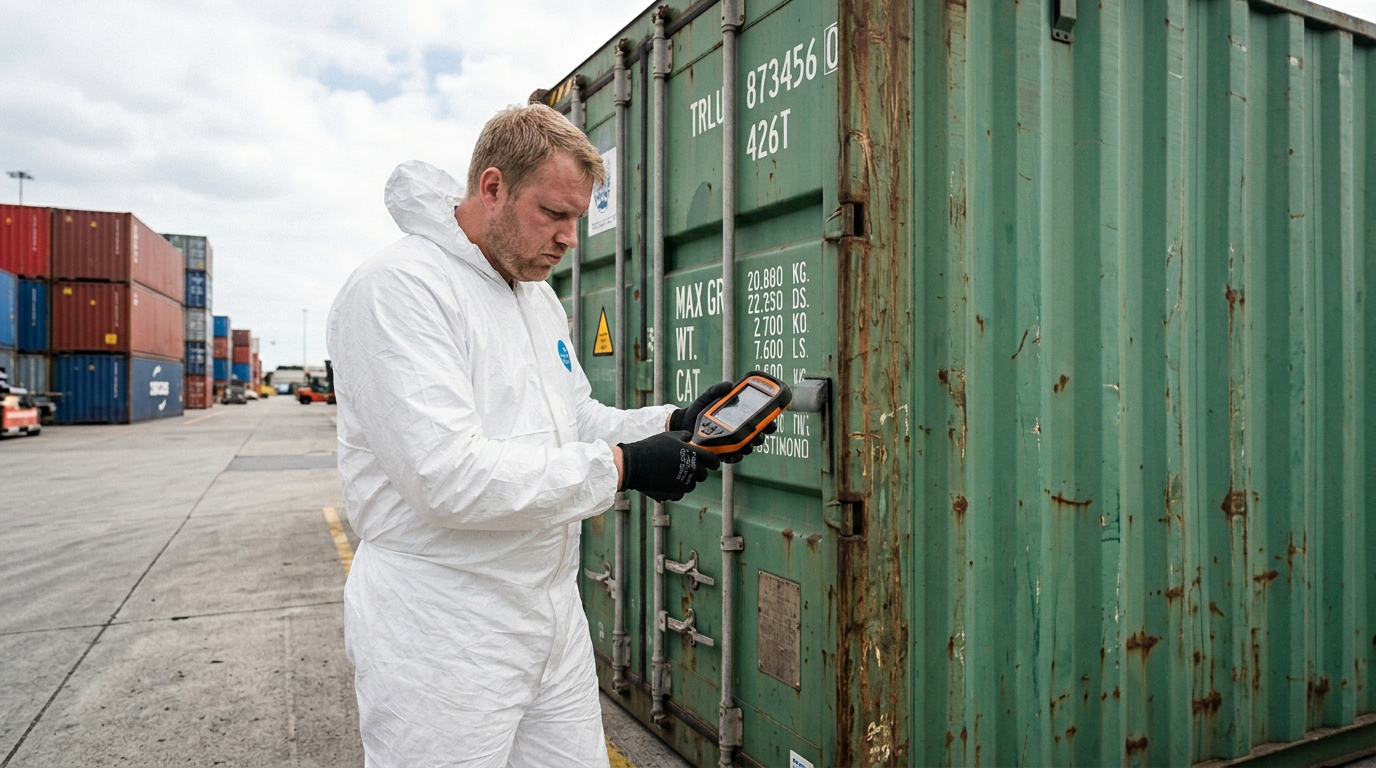
1. Two Parallel Frameworks: IMDG Code and NIA 1965
When a vessel owner receives an enquiry for radioactive cargo, two distinct regulatory frameworks apply simultaneously and they answer different questions.
The IMDG Code answers the transport question: how must this cargo be classified, packed, labelled, documented and stowed. Under IMDG 2.7.1.1, radioactive material is defined as any material where both the activity concentration and the total activity in the consignment exceed the radionuclide-specific values in Table 2.7.2.2.1 to 2.7.2.2.6. There is no single blanket threshold — every radionuclide has its own A1 and A2 values. [IMDG Code, 2.7.2.2.1]
The Nuclear Installations Act 1965 (NIA 1965) answers the insurance question. All four major clubs (West of England, UK P&I, Gard and Britannia) apply NIA 1965, not the IMDG Code, as the coverage test.
1.1 What is “Excepted Matter”?
Section 26 of NIA 1965 defines “Excepted Matter” — the only category covered under a standard P&I entry — as nuclear matter consisting only of:
- Isotopes prepared for industrial, commercial, agricultural, medical, scientific or educational purposes [Gard, Guidance to Rule 73, fn.2 — NIA 1965 s.26(a)]
- Natural uranium
- Uranium in which isotope 235 forms not more than 0.72%
- Small prescribed quantities of nuclear matter as may be specified by regulation
Note: West of England P&I (UWG-RC-GBR-19-V1) and Britannia/IG Circular 1969 (Appendix II, Category II(c)) list only industrial, commercial, agricultural, medical and scientific purposes. “Educational” appears in NIA 1965 s.26(a) — the governing statutory text — as cited in Gard, Guidance to Rule 73, fn.2.
2. The Britannia Classification: Four Types of Sea-Carried Radioactive Material
The Britannia/IG circular of November 1969 sets out four classes of sea-carried radioactive material subsequently mapped to two statutory categories under NIA 1965.
| Class | Type | Description | P&I Status |
|---|---|---|---|
| Class I | Ores & concentrates | Natural uranium and thorium ores, concentrates and metals; sludges and “throw-away wastes”. Radioactive content “no greater than that of common lead.” [Britannia/IG Circular 1969, Appendix I (1960)] | Excepted Matter ✓ |
| Class II | Radioisotopes | Isotopes for science, medicine, agriculture and industry. Required only in small unit quantities. Includes teletherapy sources. [Britannia/IG Circular 1969, Appendix I (1960)] | Excepted Matter ✓ |
| Class III | Fissile material | Enriched uranium, U-235, Pu-239. Toxic if ingested. Capable of a criticality incident above certain quantities and geometry. [Britannia/IG Circular 1969, Appendix I (1960)] | Conditional ⚠ |
| Class IV | Irradiated fuel & HLW | “The radiation would be of such intensity as to cause grave, if not fatal injury… This type of nuclear substance is by far the most dangerous.” [Britannia/IG Circular 1969, Appendix I (1960)] | Always excluded ✗ |
“Broadly speaking, Classes III and IV fall within the ‘nuclear matter other than excepted matter’ category, and Classes I and II fall within the ‘excepted matter’ category.” [Britannia/IG Circular 1969, 6(1)] Clubs extended cover “to all substances falling under the category of ‘excepted matter’.” [Britannia/IG Circular 1969, 7]
3. Decision Guide: Is This Cargo Covered Under Standard P&I?
The table below represents the decision sequence for any radioactive cargo enquiry.
| Decision | YES → outcome | NO → outcome |
|---|---|---|
| Is this IMDG Class 7 radioactive material? | Proceed to next check | Not a Class 7 material — standard cargo rules apply |
| Qualifies as Excepted Matter (NIA 1965 s.26)? | Standard P&I cover applies ✓ Verify per consignment | Proceed to next check |
| Radioactive waste or Class IV (irradiated fuel/HLW)? | ALWAYS EXCLUDED ✗ Never covered | Contact Club underwriting BEFORE accepting |
| Club confirms Excepted Matter? | Standard P&I cover confirmed ✓ | Certificate of Financial Security required from consignor (government countersigned) before loading |
Figure 1 — P&I cover decision sequence for radioactive cargo enquiries. Main vertical path = ambiguous cases. Side exits = confirmed outcomes.
4. What Can Be Carried Under Standard P&I Cover?
- Radioisotopes for industrial, commercial, agricultural, medical or scientific purposes. [West of England P&I, UWG-RC-GBR-19-V1, Exclusions (a)] [Britannia/IG Circular 1969, Appendix II, Category II(c)] NIA 1965 s.26(a) also covers educational purposes. [Gard, Guidance to Rule 73, fn.2]
- Uranium and thorium ores and concentrates (UOC) — unirradiated. [West of England P&I, UWG-RC-GBR-19-V1] [Britannia/IG Circular 1969, Appendix II, Category II(a)]
- Natural or depleted uranium metal, thorium metal and alloys or chemical compounds — unless irradiated in a nuclear reactor. [Britannia/IG Circular 1969, Appendix II, Category II(b)] [West of England P&I, UWG-RC-GBR-19-V1]
- Natural non-fissile UF₆ >0.1 kg as UN 2978 — should always qualify as Excepted Matter but must be checked for misdeclaration. [UK P&I Club, Carefully to Carry 2023, 49.6]
- Radioisotopes other than those for the stated purposes, or irradiated material/samples, where activity is below the Category I(b) Curies limits. [Britannia/IG Circular 1969, Appendix II, Category II(d)]
- Small fissile quantities within Excepted Matter gram limits — fissile material in Fissile Class I or II packages within per-consignment limits below. [Britannia/IG Circular 1969, Appendix II, Category I(a)(ii)] [UK P&I Club, Carefully to Carry 2023, 49.6]
- Empty containers — certified by competent authority as free of radioactivity. [Britannia/IG Circular 1969, Appendix I (1960)] [West of England P&I, UWG-RC-GBR-19-V1, Prior Advice section]
Fissile Material Gram Limits per Consignment (Fissile Class I and II Packages Only)
Fissile material in Fissile Class III packages is always excluded regardless of quantity. [Britannia/IG Circular 1969, Appendix II, Category I(a)(i)]
| Radionuclide | Special Form (per consignment) | Other Form (per consignment) |
|---|---|---|
| U-235 | Less than 600 g | Less than 600 g |
| U-233 | Less than 375 g | Less than 375 g |
| Pu-239 | Less than 375 g | Less than 32 g |
| Pu-241 | Less than 4.375 g | Less than 0.0175 g |
[Britannia/IG Circular 1969, Appendix II, Category I(a)(ii)] [UK P&I Club, Carefully to Carry 2023, 49.6 — 600 g U-235 limit confirmed]
5. When Must Vessel Owners Contact the Club?
5.1 Always Excluded
- Radioactive waste of any kind. See Red Flag above.
- Irradiated nuclear fuel and spent fuel (Class IV). “Nuclear materials of Class IV are, in the Committee’s opinion, so inherently dangerous as to be absolutely excluded.” [Britannia/IG Circular 1969, Appendix I (1960)] Approximately 300 sea movements to date on purpose-built ships with Type B casks. [UK P&I Club, Carefully to Carry 2023, 49.6.1]
- Fissile material (Class III) above Excepted Matter gram limits. “The Committee considers that no sufficient case has been established for the carriage, under the Association’s cover, of fissile materials.” [Britannia/IG Circular 1969, Appendix I (1960)]
- Any radioactive matter — Gard’s sweep-up exclusion. Rule 73.1(d) is drafted “in the widest terms possible” and applies whether or not the Member knew the material was radioactive. [Gard, Guidance to Rule 73, R.73.1(d) and Guidance (A), (E)]
5.2 Requiring Prior Club Approval
- Enriched UF₆ (UN 2977 / 2919 / 3331): “It is always necessary to check the total quantity of U-235 in a consignment to determine whether it is more or less than the limit of 600 g.” Example: 5 kg UF₆ at 4% enrichment contains 135.22 g U-235. [UK P&I Club, Carefully to Carry 2023, 49.6]
- Any fissile material consignment exceeding the gram limits in Section 4. [Britannia/IG Circular 1969, Appendix II, Category I(a)]
- NORM (Naturally Occurring Radioactive Material) from oil/gas production, mining, mineral sands or hydraulic fracturing. [UK P&I Club, Carefully to Carry 2023, 49.6.2]
- Any cargo declared “fissile excepted” under IMDG — Club must independently verify U-235 content against the 1.0% fissile-excepted limit. [UK P&I Club, Carefully to Carry 2023, 49.6]
6. A Documented Near-Miss: Why “Fissile Excepted” Is Not Enough
— UK P&I Club, Carefully to Carry 2023, Ch.49, p.534
The UK P&I Club’s Carefully to Carry, Consolidated Edition 2023, Chapter 49 (pages 533–534) documents the following anonymised case. [UK P&I Club, Carefully to Carry 2023, Ch.49, pp.533–534]
A Member received two consignments of uranium — one of uranium trioxide, one of uranium metal ingots. Both dangerous goods notes declared the cargo Radioactive Material, LSA-II, fissile excepted. The same notes also recorded the U-235 fissile isotope weights.
The Numbers That Saved the Day
| Item | Consignment 1 — Uranium Trioxide | Consignment 2 — Uranium Metal Ingots |
|---|---|---|
| Declared label | LSA-II, Fissile Excepted | LSA-II, Fissile Excepted |
| Actual fissile content | 5.55% U-235 | 1.23% U-235 |
| Allowable limit | 1.0% | 1.0% |
| Status | EXCEEDED ✗ | EXCEEDED ✗ |
| Outcome | Member refused both. Consignor submitted revised weights; Club’s nuclear consultant confirmed within 1.0% via consignee data. | |
7. If the Cargo Is Not Excepted Matter
- Consignor must arrange nuclear liability insurance and produce a Certificate of Financial Security countersigned by the government of the consignor’s country. [West of England P&I, UWG-RC-GBR-19-V1] [UK P&I Club, Carefully to Carry 2023, 49.6] [Britannia/IG Circular 1969, 4(e)]
- For UKAEA cargo: umbrella indemnity up to £50,000,000 per occurrence for non-Paris Convention territory claims and damage to means of transport. [Britannia/IG Circular 1969, 8]
- “If no Certificate of Financial Security is received, the shipowner will be entitled to assume that the nuclear substance which he is to carry is ‘excepted matter’.” [Britannia/IG Circular 1969, 10]
- For non-UKAEA shipments, owners must obtain adequate indemnities from the relevant authority before accepting. [Britannia/IG Circular 1969, 13]
8. Operational Action Guide
8.1 Four Steps for Every Radioactive Cargo Enquiry
- Obtain the full IMDG dangerous goods declaration: proper shipping name, UN number, radionuclide identity, physical and chemical form, activity in Bq, fissile percentage and net fissile weight in grams, waste status, and cargo gross weight. [West of England P&I, UWG-RC-GBR-19-V1, Prior Advice and Notes 1–2]
- Refer to your P&I Club underwriting department before accepting. Submit all declaration data for nuclear consultant review. [West of England P&I, UWG-RC-GBR-19-V1] [UK P&I Club, Carefully to Carry 2023, 49.6]
- If cargo is not Excepted Matter, require a government-countersigned Certificate of Financial Security from the consignor before loading. [West of England P&I, UWG-RC-GBR-19-V1] [Britannia/IG Circular 1969, 4(e)]
- Insert the Nuclear Cargo Exclusion Clause in the charterparty with a carve-out for Excepted Matter subject to owners’ prior written approval. [West of England P&I, UWG-RC-GBR-19-V1, Recommended Charter Party Clause] [Britannia/IG Circular 1969, Appendix III]
8.2 Documents to Request from Shipper Before Loading
- IMDG Dangerous Goods Declaration (Multimodal Dangerous Goods Form) — must include proper shipping name, UN number, radionuclide identity, physical/chemical form (“special” or “normal”), total activity in Bq, fissile percentage and net fissile weight in grams, waste status, gross weight. [West of England P&I, UWG-RC-GBR-19-V1, Prior Advice; Notes 1–2] [IMDG Code, para 2.7.2.4.1]
- Package Approval certificates — required for Type B(U), Type B(M), Type C packages, fissile material packages, and special form material.
- Certificate of Financial Security (Nuclear Matter Transport Certificate) — required only if cargo is not Excepted Matter. Issued by the nuclear liability insurer, countersigned by the government of the consignor’s country. If no certificate received, shipowner entitled to assume cargo is Excepted Matter. [West of England P&I, UWG-RC-GBR-19-V1] [Britannia/IG Circular 1969, 4(e) and 10]
8.3 Nuclear Cargo Exclusion Clause — Recommended Charterparty Wording
Insert in every charterparty carrying, or potentially carrying, radioactive goods:
An older International Group form excludes “nuclear fuels or radioactive products or waste” with a carve-out for industrial/medical radioisotopes. The modern WP&I form above, incorporating NIA 1965 statutory definitions, is the recommended wording for current use. [Britannia/IG Circular 1969, Appendix III and 14]
Key takeaways
● The IMDG Code governs how radioactive cargo is transported. NIA 1965 determines whether P&I covers it.
● Only Excepted Matter under NIA 1965 s.26 is covered under a standard P&I entry — verified per consignment, not by blanket approval.
● An IMDG “Excepted Package” or “fissile excepted” classification does not confirm Excepted Matter for insurance purposes.
● Radioactive waste is NEVER covered. Irradiated nuclear fuel is absolutely excluded. Fissile material is excluded unless within the Excepted Matter gram limits.
● Contact your Club before accepting any radioactive cargo enquiry where there is any doubt.
Further Reading
This article is for operational reference only and does not constitute legal or insurance advice. Consult your P&I Club directly for all coverage decisions.
Discover more from IMDG Code Compliance Centre
Subscribe to get the latest posts sent to your email.