


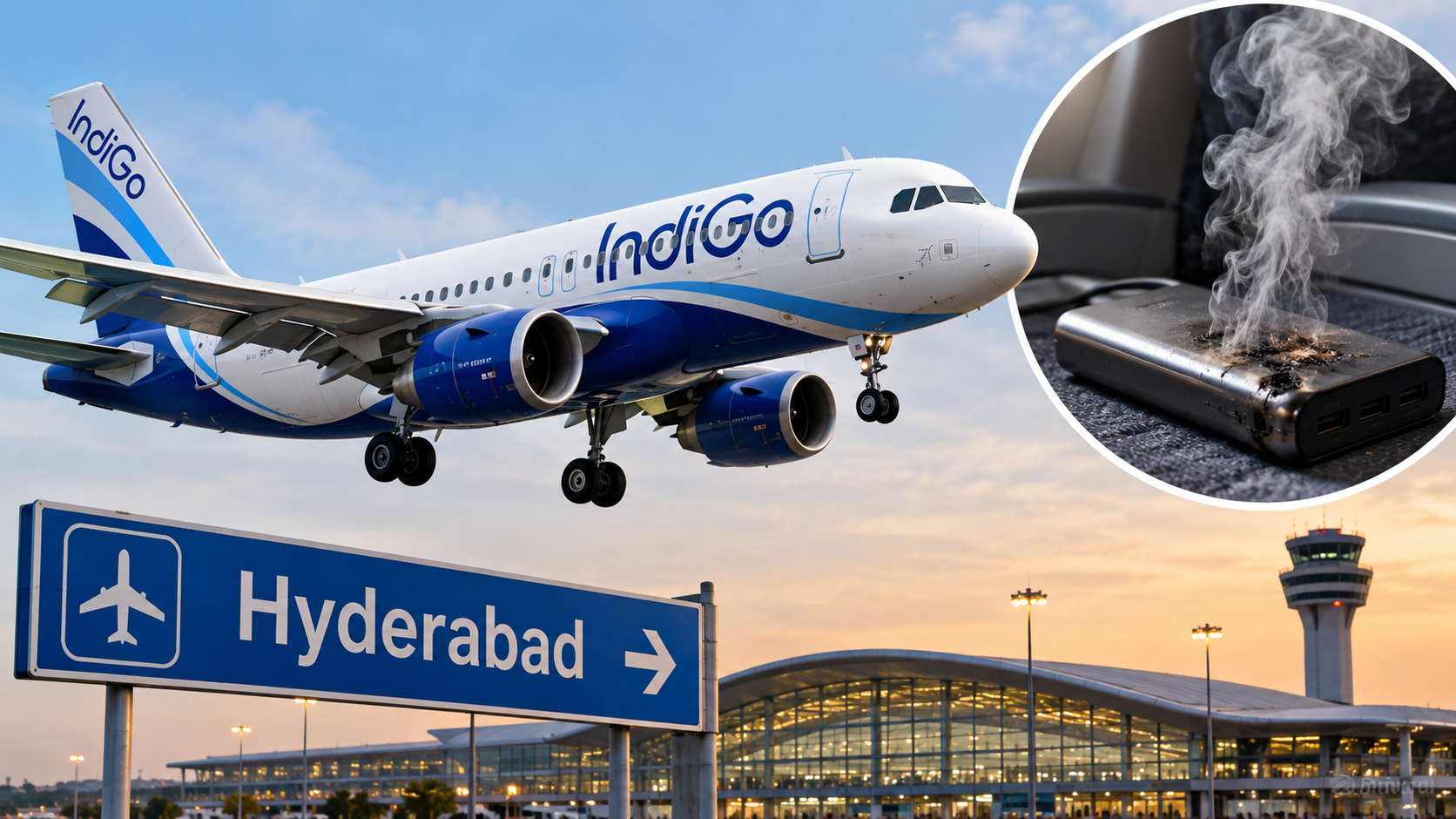
IndiGo flight 6E 6115 from Delhi to Chennai diverted to Rajiv Gandhi International Airport, Hyderabad, on 11 October 2026 after smoke was detected from a passenger’s personal electronic device. Early reports named a power bank. IndiGo’s own statement did not, and the device type and cause have not been confirmed.
What has been reported
IndiGo said the pilots diverted the flight under established safety protocols, that the cabin crew brought the situation under control before landing, and that the aircraft landed safely at Hyderabad. India Today reports that the crew used a fire extinguisher. An alternate aircraft was arranged to take passengers on to Chennai.
A passenger described a fire in a compartment inside the aircraft, with the crew trying several methods before it was controlled. That is the passenger’s account. IndiGo has not described the event in those terms.
This article relies on India Today’s report of the day. No other coverage of 6E 6115 was found at the time of writing.
Rules that apply on an Indian domestic flight
| Source | Requirement |
|---|---|
| DGCA Dangerous Goods Advisory Circular 01/2025, 11 November 2025 (addressed to air operators and airport operators) | Item (vii): operators announce that power banks and spare batteries go in hand baggage only, that power banks must not be used or charged in flight, and that heat, smoke or an unusual smell is reported to crew at once. Item (viii): power banks and spare batteries are not to be placed in overhead bins, and passengers are to be taught short-circuit prevention. Item (ix): operators report lithium battery occurrences to DGCA. |
| DGCA statement, 4 January 2026 | Power banks may not be used to charge phones or other devices at any point in flight, including through seat power outlets. |
| ICAO Technical Instructions, Addendum No. 1, approved by the ICAO Council and applicable from 27 March 2026 | No recharging of power banks on board. No more than two power banks per person. Using a power bank to charge another device is recommended against. |
DGCA is stricter than ICAO on use. ICAO’s addendum treats charging a device from a power bank as a recommendation, while DGCA’s January statement prohibits it and the circular tells operators to announce that power banks must not be used or charged in flight. The circular itself is directed at operators, who then pass its instructions to passengers.
On capacity, ICAO’s information document keeps power banks up to 100 Wh as the general case. Power banks above 100 Wh and up to 160 Wh are allowed only with operator approval, inside the two-per-person limit. For the full breakdown of the addendum, and how the IMDG Code treats the same batteries by sea (UN 3480 and UN 3481), see Power Banks Are Dangerous Goods. Start Treating Them That Way.
Why the location of a power bank matters
DGCA’s reasoning is detection time. A battery in an overhead bin or a carry-on bag is out of sight, so smoke is noticed later. The circular also notes that lithium battery fires can sustain themselves and need special handling by crew. ICAO cites a January 2025 accident in which a fire, likely started by a short circuit in a lithium-ion battery in an overhead compartment, destroyed an aircraft. ICAO does not name the aircraft; press reports of the January 2025 Air Busan fire in South Korea describe a power bank in an overhead bin.
For 6E 6115, three facts are still missing: where the device was kept, whether it was connected to another device, and whether it was being charged. Each bears on how the circular’s stowage and use instructions apply.
Earlier IndiGo incidents
- October 2025: a power bank caught fire on an IndiGo aircraft taxiing at Delhi for departure to Dimapur. The cabin crew extinguished it and no injuries were reported.
- 5 May 2026: on 6E 108, Hyderabad to Chandigarh, a passenger’s power bank caught fire as the aircraft taxied to its bay. All 198 passengers and six crew were evacuated using slides.
Both of those fires happened on the ground, with the aircraft taxiing.
What passengers should do
- Carry power banks in hand baggage, never in checked baggage and never in an overhead bin.
- Do not switch one on in flight, and do not recharge one from a seat outlet.
- Keep to two power banks per person.
- Protect against short circuits: put the power bank in a plastic bag or protective case, or tape over exposed terminals.
- Tell the crew immediately if any device gets hot, smokes or smells unusual.
No cause for 6E 6115 has been reported as of 11 October 2026; check DGCA and IndiGo statements before quoting one. For shipping batteries by sea, use the Battery UN Number Finder.
Sources
- India Today, 11 October 2026
- DGCA Dangerous Goods Advisory Circular 01/2025, F.No. DGCA-13008/37/2025-IR-DGCA, dated 11.11.2025
- ICAO, Information related to Addendum No. 1 to the 2025-2026 Technical Instructions
- IANS, DGCA statement of 4 January 2026
- Bernama-Xinhua, 5 May 2026
- WION, October 2025 Delhi incident and circular summary
Discover more from IMDG Code Compliance Centre
Subscribe to get the latest posts sent to your email.