


The 1962 Warning That Started It All
The problem of ports and carriers refusing IMDG-compliant radioactive cargo is older than the IMDG Code itself. The proceedings of the US Atomic Energy Commission Transport Symposium, held in Germantown, Maryland in December 1962, record the following from a UK competent authority representative: [Gorlin, S. (WNA), IAEA Technical Meeting on Denials of Shipment, March 2021 — citing AEC Transport Symposium proceedings, December 1962]
That sentence describes the structural problem precisely. It was spoken over sixty years ago. In 2026, the entities refusing are no longer station-masters. They are the world’s largest container lines, managing fleets of 24,000-TEU vessels, and port authorities that block cargo for administrative or commercial reasons that have nothing to do with safety. The power to refuse has not diminished. The understanding of the regulations has not reliably improved.
It was not until the IAEA Conference on the Safety of Transport of Radioactive Material in Vienna in July 2003 that the issue was officially and formally recognised at international level, and a concerted effort to address it was initiated. [Gorlin, S. (WNA), IAEA Technical Meeting on Denials of Shipment, March 2021]
The Three IMO Instruments: What They Said and What Authority They Carried
1. IMO FAL.6/Circ.12 — 11 July 2005
The Annex to FAL.6/Circ.12 contains two elements that matter. First, the general position on all Class 7 cargo:
Second, the specific Cobalt-60 advice: Member Governments should facilitate its shipment because it sterilizes approximately 45% of all single-use medical supplies used worldwide and is used in cancer treatment. [IMO FAL.6/Circ.12, 11 July 2005, Annex paragraph 2] The circular asked Member Governments to bring it to the attention of ship owners, operators, masters and port operators, and to report instances of refusal to the Committee.
What the circular could not do is compel any private carrier to carry anything. A FAL circular is addressed to Member Governments. It is advisory in nature. A shipping line is not a Member Government. The circular carries no legal force against a carrier that chooses to refuse.
2. IMO Assembly Resolution A.984(24) — 1 December 2005
The resolution reaffirmed that SOLAS chapter VII and the IMDG Code contain sufficient and adequate provisions for the safe carriage of Class 7 radioactive materials. Look at the wording of its key paragraphs. Each one reveals how far short the Assembly fell of what was actually needed:
Paragraph 2: Also invites Member Governments to recognise the beneficial uses of Class 7 materials and to facilitate their expeditious transportation.
Paragraph 3: Further invites Member Governments to work with national authorities and industry associations.
Paragraph 4: Urges Member Governments and NGOs to bring instances of refusal to the Facilitation Committee.
Paragraph 5: Requests the Facilitation Committee to continue working with the IAEA.
Invites. Also invites. Further invites. Urges. Requests. The word requires does not appear. The word prohibits does not appear. No Member Government was legally bound to do anything. No carrier was bound at all. [IMO Assembly Resolution A.984(24), 1 December 2005, operative paragraphs 1–7]
3. FAL 42/16/1 — June 2018 (WNTI Submission)
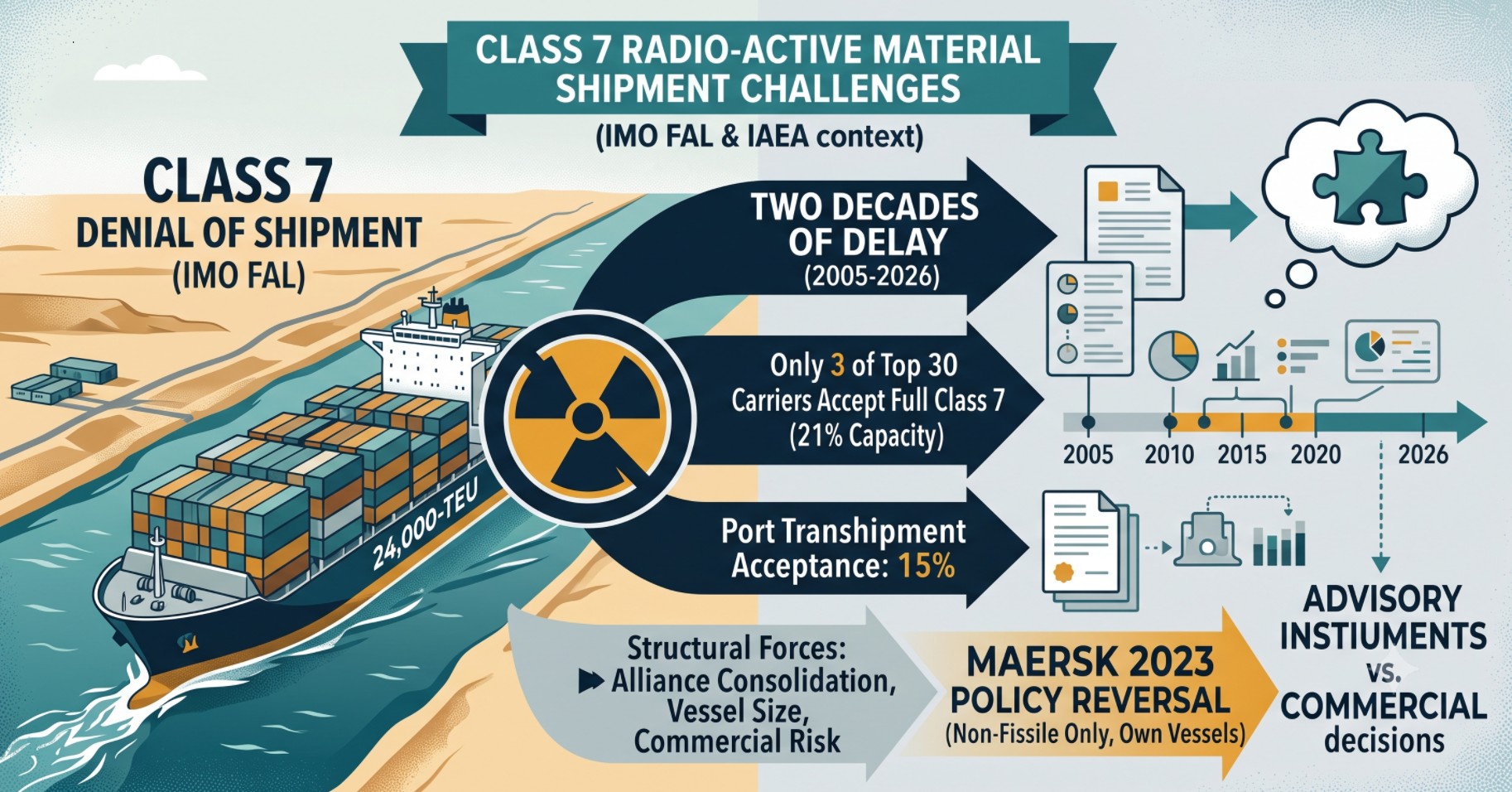
FAL 42/16/1 contained the most precisely quantified picture of the Class 7 acceptance problem that had been placed before the IMO to that date. Its analysis of the thirty leading container and liner operators produced the headline finding that my 2018 article referenced: only three of the top thirty carriers — CMA CGM, Hapag-Lloyd and Zim — offered services to the whole of the Class 7 market at the time of the analysis, together accounting for 21% of global container capacity. [WNTI market analysis for FAL 42/16/1, IMO FAL Committee 42nd session, June 2018; cited in Gorlin (WNA), IAEA TM on DoS, March 2021]
The FAL Committee accepted the paper and encouraged Member Governments to reinforce the messages in previous circulars and resolutions. No new binding instrument was created. The circle of encouragement completed another loop.
What Happened Between the Instruments: The ISC Story
The 2005 instruments did generate action. The IAEA constituted the International Steering Committee on Denials of Shipment of Radioactive Material (ISC) in 2006. Over seven years it built a network of over seventy National Focal Points across member states, ran regional workshops in Africa and Latin America, and produced training programmes and awareness materials. Its most practical achievement was with airlines: Air Canada agreed to prioritise certain radioactive cargo over other freight — a policy it maintained after the ISC closed. [Gorlin, S. (WNA), IAEA TM on DoS, March 2021]
The ISC set 2013 as its target year to make denial and delay “insignificant.” In 2013 the IAEA dissolved the ISC. Director General Amano, speaking at the closing ceremony, said that a high proportion of the 30 Member States he visited each year complained about transport issues that hinder the receipt of radioactive material. The ISC was closed before its goals were achieved, and the National Focal Point network it had built was dissolved with it. [Gorlin, S. (WNA), IAEA TM on DoS, March 2021]
In 2014 the Transport Facilitation Working Group (TFWG) was established by former ISC chairs and interested parties to continue the work informally. It had no mandate from the IAEA or IMO and no authority over any carrier or port. [Gorlin, S. (WNA), IAEA TM on DoS, March 2021]
Three Structural Forces Making It Worse
1. Alliance Consolidation
In 2005, when FAL.6/Circ.12 was issued, there were ten shipping alliances. By 2017 there were three. [WNTI, FAL 42/16/1, June 2018; cited in Gorlin (WNA), IAEA TM on DoS, March 2021] Within an alliance, carriers share cargo space through slot-charter arrangements. If one alliance partner does not accept Class 7, the entire slot arrangement cannot accommodate it regardless of the booking carrier’s own policy.
This is how the Maersk acquisition of P&O Nedlloyd worked against the market. P&O Nedlloyd had a history of accepting radioactive materials. After the acquisition, Maersk’s prohibition applied, and shippers who had previously used that network found their option closed. As consolidation continued, the cumulative effect was a steady contraction in the number of vessels willing to carry Class 7 on any given trade lane.
2. Vessel Size
The mega-vessel era has added a different dimension of risk for carriers. A vessel carrying Class 7 faces the possibility of refusal at intermediate ports during its voyage rotation. If a port authority refuses entry to a vessel carrying radioactive material — even material fully compliant with SOLAS and the IMDG Code — the commercial and schedule disruption to a 24,000-TEU vessel is severe. Carriers have rationally decided that the commercial risk of one consignment of Class 7 is not worth the potential cost of being turned away at a major hub.
3. The Commercial Calculus: Why Refusing Makes Business Sense
Port disruption risk is only part of the picture. For a carrier to routinely accept Class 7 cargo, it must absorb a set of internal compliance costs that do not apply to general cargo. These costs are disproportionate to the revenue from a handful of radioactive packages on a vessel that might otherwise carry 20,000 boxes of consumer goods.
- Crew training and certification. IMDG regulations require DG-trained personnel to handle dangerous goods, including Class 7. Regular training, certification renewal and operational awareness programmes add to crew management costs that do not arise for a carrier that simply excludes the cargo.
- Insurance and P&I conditions. Some P&I clubs apply additional scrutiny or conditions to members carrying nuclear-related cargo. Even for cargo that qualifies as Excepted Matter, the carrier must navigate the NIA 1965 coverage framework discussed in my separate article on this subject.
- Documentation burden. Each Class 7 consignment requires a complete dangerous goods declaration, Competent Authority Approval certificates for Type B and fissile packages, Transport Index calculations, and Criticality Safety Index data for fissile material. The documentation workload is substantially higher than for general cargo, with any error or omission creating liability exposure for the carrier.
- Security requirements. IAEA security guidance recommends that shipments of radioactive material travel by direct, pre-planned routes under continuous supervision — reducing the operational flexibility that alliance networks and multi-port rotations require.
- Revenue versus risk profile. Class 7 represents a very small fraction of any major carrier’s potential freight. Five radioactive packages on a 20,000-TEU vessel earn the same freight as five boxes of household goods — but carry the risk of the entire vessel being refused entry to an intermediate port. The commercial calculus is not irrational. It is the predictable outcome of a system that imposes compliance costs on acceptance and zero cost on refusal.
This is why the IAEA’s own Denial of Shipment Working Group identified “cost of compliance related to the profitability of transporting Class 7” as a root cause. Advisory instruments cannot change this cost-benefit calculation. Only a mechanism that alters the cost of refusal — regulatory, financial or reputational — will do that. ‘ + SRC + ‘[World Nuclear News, September 2025; ICAO A42-WP/439 Rev.1]’ + E + ‘
4. Suez Canal: Permitted on Paper, Operationally Constrained in Practice
The Suez Canal Authority’s Rules of Navigation (Chapter XVIII: Vessels Carrying Radioactive Substances) do not prohibit Class 7 transit. They divide radioactive cargo into two groups with different conditions:
Group 1: fissile materials including enriched uranium and plutonium-239 (Pu-239), and irradiated uranium Note: The SCA Chapter XVIII text lists “enriched uranium, uranium-235 and plutonium-239.” Uranium-235 is an isotope of uranium, not a separate material type. In IMDG transport classification, enriched uranium and uranium-235 are not distinct categories — enriched uranium is uranium with U-235 content above the natural 0.72%. The operative distinction for transport purposes is the UN number and fissile category under the IMDG Code. Prior approval of the Egyptian Atomic Energy Establishment (A.E.E.) must be obtained first. The SCA will not authorise transit until the A.E.E. notifies them of its approval. Both must say yes before the shipment is loaded. Compensation warranty of minimum USD 20 million from an approved P&I organisation, backed by a guarantee certificate from a recognised Atomic Energy Authority. Placed at end of convoy with a 20-minute interval from the preceding vessel.
The A.E.E. prior approval requirement for Group 1 creates a significant operational hurdle. The approval must be in place before the cargo is loaded — not on arrival at Port Said. If A.E.E. approval is delayed or refused, the shipment cannot proceed. WNTI reported to the IMO in 2018 that vessels already at sea with Class 7 cargo encountered operational difficulty at the Canal in 2015. [WNTI, FAL 42/16/1, IMO FAL Committee 42nd session, June 2018; cited in Gorlin (WNA), IAEA TM on DoS, March 2021] The rules do not prohibit transit — but when the approval process stalls, the practical outcome for the shipper is the same as a prohibition.
This is one of the most instructive illustrations of the denial of shipment problem. The SCA’s written rules permit transit. The operational reality — approval processes, A.E.E. timelines, compensation warranty requirements — creates barriers that produce the same outcome as a prohibition without formally being one.
The Chronology: Seventeen Events in Twenty-Plus Years
AEC Transport Symposium records first documented complaint about port and terminal refusals of radioactive cargo despite regulatory compliance.
IAEA Vienna Conference on Transport of Radioactive Material formally recognises denial of shipment as a problem requiring international action.
IAEA convenes a Fact Finding Discussion Forum at IMO headquarters in London. IMO Facilitation Committee 31st session places Class 7 denial of shipment on the agenda.
FAL.6/Circ.12 issued, 11 July 2005. IMDG-compliant Class 7 “should be considered as meeting the necessary safety requirements and should be facilitated.” Advisory only.
IMO Assembly Resolution A.984(24) adopted. Higher authority than the FAL circular. Invites, urges, requests. Does not require.
IAEA constitutes the International Steering Committee on Denials of Shipment. Maersk completes acquisition of P&O Nedlloyd; Class 7 acceptance previously provided by P&O Nedlloyd is removed from the market.
ISC active: National Focal Points established in over 70 member states, regional workshops, training programmes, Air Canada policy secured. Target of making denial “insignificant” by 2013 not achieved.
President of IAEA Conference on the Safe and Secure Transport of Radioactive Materials: “Denial of shipments continues to be a problem that must be addressed.”
IAEA dissolves the ISC. National Focal Point network dismantled. Transport Facilitation Working Group formed informally — no IAEA or IMO mandate.
WNTI reported in its 2018 FAL submission that vessels already at sea with Class 7 cargo encountered difficulty at the Suez Canal. [WNTI, FAL 42/16/1, June 2018; cited in Gorlin (WNA), IAEA TM on DoS, March 2021] The SCA’s Rules of Navigation (Chapter XVIII) permit transit subject to conditions — Group 1 requires prior A.E.E. approval, Group 2 requires documentation on arrival. The source of the operational difficulty was the approval process, not a formal rule change or prohibition.
FAL 42/16/1: WNTI submits paper to IMO FAL 42nd session. Of the thirty leading container and liner operators, only CMA CGM, Hapag-Lloyd and Zim accept the full Class 7 market (21% of global capacity). FAL Committee encourages Member Governments to reinforce previous messages. No new instrument issued. See my December 2018 article.
IAEA General Conference Nuclear Safety Resolution calls for a Technical Meeting to examine the idea of a Code of Conduct on facilitation of Class 7 transport. TM originally scheduled for April 2020.
COVID-19 pandemic. Grounding of passenger aircraft removes air cargo capacity for medical radioisotopes. Supplies of Mo-99/Tc-99m generators disrupted globally. Nuclear medicine services in parts of Central America paralysed for six months. KLM temporarily accepts Class 7 by air for five weeks and then reverts to its standard refusal policy. [Gorlin, S. (WNA), IAEA TM on DoS, March 2021]
IAEA Technical Meeting on Denials of Shipment. WNTI/WNA paper analyses 84 key international ports: 74% accept loading/unloading, 74% accept transit, only 15% accept transhipment. TFWG 2020 survey of 57 Class 7 shippers: 35% said the situation had deteriorated over the previous three years. [TFWG 2020 survey, as reported in Gorlin (WNA), IAEA TM on DoS, March 2021]
Maersk reverses its Class 7 prohibition. For the first time since the P&O Nedlloyd acquisition, Maersk accepts non-fissile Class 7 from audited shippers on Maersk-operated vessels, subject to port restrictions. [Maersk, Best Practice to Transport: Class 7 — Radioactive Material, September 2023, published 19 October 2023] Significant conditions apply.
IAEA Denial of Shipment Working Group established, with a mandate from 2023 to 2026, spearheaded by the World Nuclear Association with ICAO and multiple IAEA Member States. A draft Code of Conduct on Facilitation of Safe and Secure Transport of Radioactive Materials was prepared but was not agreed by member states. A non-legally-binding Joint Statement is being developed as an alternative.
The gap identified by FAL.6/Circ.12 in 2005 remains open. No binding legal instrument has been created compelling carriers or ports to accept IMDG-compliant Class 7 cargo.
What the 2021 IAEA Data Shows
The clearest quantification of the current situation comes from the WNTI/WNA paper presented at the IAEA Technical Meeting on Denials of Shipment in March 2021. Its analysis of 84 international ports required for the global distribution of sealed sources produced the following acceptance rates: [Gorlin, S. (WNA), IAEA TM on DoS, March 2021]
| Operation | Acceptance rate across 84 key ports |
|---|---|
| Loading and unloading | 74% |
| Transit (cargo remains on vessel while other cargo loads/discharges) | 74% |
| Transhipment (offloaded from one ship and loaded onto another) | 15% |
A 74% port acceptance rate for loading and unloading might suggest that the problem is manageable. It is not, and the reason is that a single acceptance rate at a single port tells only part of the story. For a shipment to move from consignor to consignee by sea, every node in the chain must independently say yes. At each node, a separate commercial or administrative decision can end the shipment.
- At the port of loading: The port must accept Class 7. The specific terminal within that port used by the booking carrier must accept Class 7 — not all terminals within an accepting port have trained staff, equipment or authority to handle it. The national competent authority of the exporting country must have issued the required export documentation, and for Group 1 materials any required prior approvals must be in place before the vessel arrives.
- At the carrier level: The booking carrier must accept Class 7. But the booking carrier and the vessel operator are frequently not the same entity. In an alliance, cargo booked with Carrier A may be placed on a vessel operated by Carrier B under a slot-sharing arrangement. If Carrier B does not accept Class 7 — and as of 2026 most do not — the shipment cannot proceed on that sailing regardless of Carrier A’s own policy. The booking confirmation means nothing if the vessel operator says no.
- Along the voyage: Every port on the vessel’s rotation that is called before the port of discharge must accept a vessel carrying Class 7 in transit. A vessel sailing a fixed rotation cannot deviate. If one intermediate port on a multi-port rotation refuses entry to a vessel carrying Class 7, either the cargo is offloaded before that port — creating an unplanned transhipment — or the cargo never loads in the first place.
- At any transhipment hub: If a direct service is not available and transhipment is required, a second complete cycle of approvals begins. The hub port must accept Class 7 transhipment. Only 15% of the 84 key international ports do. A second carrier must accept the onward leg. A second vessel must be willing to carry it. A second set of port rotation constraints applies.
- At the port of discharge: The destination port must accept Class 7. The terminal must accept it. National import requirements and competent authority approvals must be satisfied. For time-sensitive medical radioisotopes, any delay at the destination port degrades the product. A Mo-99/Tc-99m generator that decays while awaiting clearance is a generator that cannot treat a patient.
The chance of all these conditions being met at the same time — for a specific origin, a specific destination, on a specific sailing date — is far lower than any single acceptance figure suggests. This is why shippers describe their supply chains as fragile even when their individual shipments are executing on time. They are not operating inside a reliable system. They are finding a way through a chain of independent gates, any one of which can close at any time — without notice, and without any regulatory rule being broken.
The Maersk 2023 Policy Reversal: What It Is and Is Not
In October 2023 Maersk published a new Best Practice to Transport document announcing that it would accept non-fissile Class 7 cargo from audited and approved shippers. This reverses the prohibition that had applied since the P&O Nedlloyd acquisition in 2006. Maersk is the world’s second-largest container line by capacity.
Maersk now accepts: UN2908 through UN2913 (Excepted Packages and LSA-I/SCO), UN2915 (Type A, non-special form), UN2916 (Type B(U)), UN2917 (Type B(M)), UN3321 and UN3322 (LSA-II and LSA-III).
Maersk does not accept: articles manufactured from depleted uranium (UN2909), radioactive material under special arrangement (UN2919), fissile UF₆ (UN2977), non-fissile UF₆ (UN2978), Type C packages (UN3323), radioactive material with a subsidiary hazard, or radioactive waste.
The owned-vessel condition is the critical caveat. Within the Gemini Cooperation (Maersk’s alliance with Hapag-Lloyd), cargo regularly moves on partner vessels. The booking carrier’s policy and the vessel’s policy are not the same thing, and a Class 7 consignment placed on a non-Maersk vessel cannot move under this policy. The constraint works in both directions. Hapag-Lloyd accepts the full Class 7 market including UN2978 (non-fissile UF₆), but if a Hapag-Lloyd booking results in cargo being placed on a Maersk-operated vessel within the alliance, that cargo cannot move if it falls within Maersk’s excluded categories — UN2978 among them. Neither carrier’s policy is internally inconsistent. The conflict arises at the point where slot-sharing makes the booking carrier and the vessel operator different entities. For Class 7 cargo, this is not a technicality. It is a route failure. The exclusion of UN2978 (natural and depleted non-fissile UF₆ — a commodity in the uranium fuel cycle moved between conversion and enrichment facilities) from Maersk’s acceptance is also notable.
Current Carrier Landscape (2026)
| Carrier | Class 7 policy | Key conditions |
|---|---|---|
| Maersk | Non-fissile only — re-entered October 2023 | Audited shippers; Maersk-operated vessels only; UN2978/2977/3323 and waste excluded |
| CMA CGM | Full Class 7 market | Own-operated vessels normally required; chartered vessels generally cannot accept. Source: WNTI analysis, 2018 |
| Hapag-Lloyd | Full Class 7 market | Same owned-vessel caveat applies. Source: WNTI analysis, 2018 |
| Zim | Full Class 7 market | Primarily own-operated fleet; smaller capacity |
| MSC | Excepted Packages accepted; Type A/LSA/SCO case-by-case | No published standalone Class 7 policy document; world’s largest carrier by capacity |
| COSCO | Type A and limited Type B | Case-by-case approval required |
| Evergreen, ONE, Yang Ming, HMM | Excepted Packages only for standard booking | No published Class 7 acceptance policy beyond excepted packages |
Three of the top thirty carriers accept the full Class 7 market. With Maersk’s partial re-entry in 2023, the effective market coverage for non-fissile Type A and Type B cargo has improved modestly — but the world’s largest carrier by capacity, MSC, has published no Class 7 policy at all. The alliance-level dynamic means that even the carriers with open policies cannot guarantee Class 7 acceptance on every vessel operating their branded services.
The Latest Attempt: IAEA Denial of Shipment Working Group (2023–2026)
The IAEA established a new Denial of Shipment Working Group in 2023, with a mandate running to 2026. It was spearheaded by the World Nuclear Association and includes ICAO and representatives from over twenty IAEA Member States including Argentina, Australia, Brazil, Canada, France, Germany, Italy, Japan, Singapore, the United Kingdom and the United States. [ICAO document A42-WP/439 Rev.1, ICAO Assembly 42nd session; World Nuclear Association, September 2025]
The Working Group identified the core causes of transport difficulties as: regulatory variation between member states, perception among involved parties about the risks of Class 7, complexity in national and local policies, and “cost of compliance related to the profitability of transporting Class 7.” [World Nuclear News, September 2025, reporting on IAEA DoS WG session] That last item is the most direct acknowledgement yet from an IAEA-mandated group that the economic calculus for carriers is itself a structural barrier.
The downgrade from Code of Conduct to Joint Statement matters. A Code of Conduct, however non-binding, provides a structured political commitment framework with defined implementation processes and benchmarking. A Joint Statement is a political declaration. The weakening of the instrument reflects the difficulty of achieving consensus even on non-binding commitments in this area.
The Scorecard: 2005 to 2026
| Dimension | 2005 | 2026 | Direction |
|---|---|---|---|
| Shipping alliances | 10 | 2–3 (restructuring) | Worse |
| Carriers accepting full Class 7 market (of top 30) | Unknown but higher | 3 (21% of global capacity) | Worse |
| Maersk policy | Accepting (pre-P&O Nedlloyd acquisition) | Partial re-entry: non-fissile, Maersk-operated vessels only, audited shippers (October 2023) | Partially improved |
| Port transhipment acceptance | Not measured | 15% of 84 key ports (IAEA 2021) | Chronic |
| Suez Canal access | Transit permitted with conditions | Transit still formally permitted under SCA Rules of Navigation Chapter XVIII — Group 2: documentation on arrival; Group 1: prior A.E.E. + SCA approval. Operational friction remains a practical barrier for Group 1. | Procedurally harder for Group 1 |
| Binding legal instrument | None | None | No change |
| IAEA coordination mechanism | ISC being formed (2006) | ISC dissolved 2013; TFWG (2014, no mandate); DoS WG (2023–2026, active) | New WG active |
| Code of Conduct on facilitation | Not proposed | Draft prepared, not agreed by member states; Joint Statement in development | In progress but weakened |
Why Advisory Instruments Cannot Close This Gap
Every IMO instrument on this subject — FAL.6/Circ.12, Resolution A.984(24), FAL 42/16/1 — is advisory. All three are addressed to governments. None of them speaks directly to a shipping line. None creates an obligation on any carrier to carry any cargo. A carrier that refuses is not breaking any rule.
The IMDG Code, made mandatory under SOLAS chapter VII, governs how radioactive cargo must be packed, labelled, documented and stowed when a carrier agrees to carry it. It does not obligate any carrier to accept any cargo. [SOLAS Chapter VII; IMDG Code, Chapter 1.1.1 — IMDG 42-24]
There is no SOLAS provision, no IMO Assembly resolution and no FAL circular that creates a legally enforceable obligation on a private container line to accept IMDG-compliant Class 7 cargo. Carriers refuse on commercial and risk management grounds. Nothing in the current international legal framework prevents them from doing so.
The IAEA’s own Denial of Shipment Working Group identified “cost of compliance related to the profitability of transporting Class 7” as a cause of denial. [World Nuclear News, September 2025; ICAO A42-WP/439 Rev.1] This is the most direct acknowledgement yet of what maritime practitioners have known for decades: the problem is commercial, and advisory instruments addressed to governments do not change commercial decisions made by private companies.
What Needs to Happen
The Code of Conduct that was proposed in 2019 and assigned to the IAEA Working Group in 2023 has already been blocked at member state level. The instrument being developed in its place — a Joint Statement — carries less political weight than a Code of Conduct and far less than a Convention.
Even if the Joint Statement is finalised and adopted, the IAEA Working Group’s own analysis suggests the structural barriers will remain unless the following are addressed:
- National Focal Points in every country with a mandate to coordinate between regulators, shippers and port authorities and to resolve specific denial events — not just to collect reports.
- Minimum port infrastructure requirements: every country to maintain at least two ports capable of loading, unloading, transit and transhipment of Class 7. Without this, supply chains to entire countries remain dependent on a single port’s operational policy.
- Non-discrimination in transit: countries not blocking Class 7 cargo transiting their ports when the final destination is another country. Blocking transit harms neither the blocking country nor its population — it harms the consignee in a third country.
- Transparency on carrier and port policies: carriers and ports to publicly declare their Class 7 acceptance positions, including vessel-by-vessel and terminal-by-terminal conditions. The gap between booking carrier policy and vessel-operator policy is currently invisible to shippers until a consignment is refused.
None of these proposals requires a carrier to carry anything. They address the informational and infrastructure conditions that make refusals harder to disguise and alternative routes easier to find. That is a more achievable goal than compelling acceptance — but it requires governments to act, not merely to invite themselves to act.
Where this leaves us
● FAL.6/Circ.12 (2005) said IMDG-compliant Class 7 should be facilitated. It remains advisory.
● Resolution A.984(24) (2005) elevated that message to Assembly level. It remains advisory.
● FAL 42/16/1 (2018) documented that the problem had not improved. The FAL encouraged Member Governments to reinforce previous messages. Advisory.
● The IAEA DoS Working Group (2023–2026) drafted a Code of Conduct. Member states did not agree it. A Joint Statement is in development.
● Twenty years, four instruments, one ISC formed and dissolved, one TFWG formed with no mandate, one Working Group with a mandate but a weakened output — and the gap between what the IMDG Code permits and what carriers and ports accept remains open.
● The only binding instrument that governs Class 7 sea transport is the IMDG Code. It tells carriers how to carry it. It does not tell them they must.
Further Reading
Have you experienced difficulties shipping Class 7 cargo by sea?
Whether it is a carrier refusal, a port that would not load or discharge, a transhipment hub that said no, or an approval process that stalled — your experience matters. The denial of shipment problem is difficult to quantify precisely because most incidents go unreported.
If you are willing to share your experience — anonymously if you prefer — please leave a comment below or contact us directly. Your account may help make the case to the IMO, the IAEA and the industry that this problem is real, current and consequential.
This article is for informational purposes. Port acceptance rate data (74%/74%/15%) from the WNTI/WNA paper at the IAEA Technical Meeting on Denials of Shipment, March 2021. Carrier acceptance data reflects publicly available information as at mid-2026 and should be verified directly with carriers before booking. Suez Canal rules cited from SCA Rules of Navigation 2020, Chapter XVIII.
Discover more from IMDG Code Compliance Centre
Subscribe to get the latest posts sent to your email.