


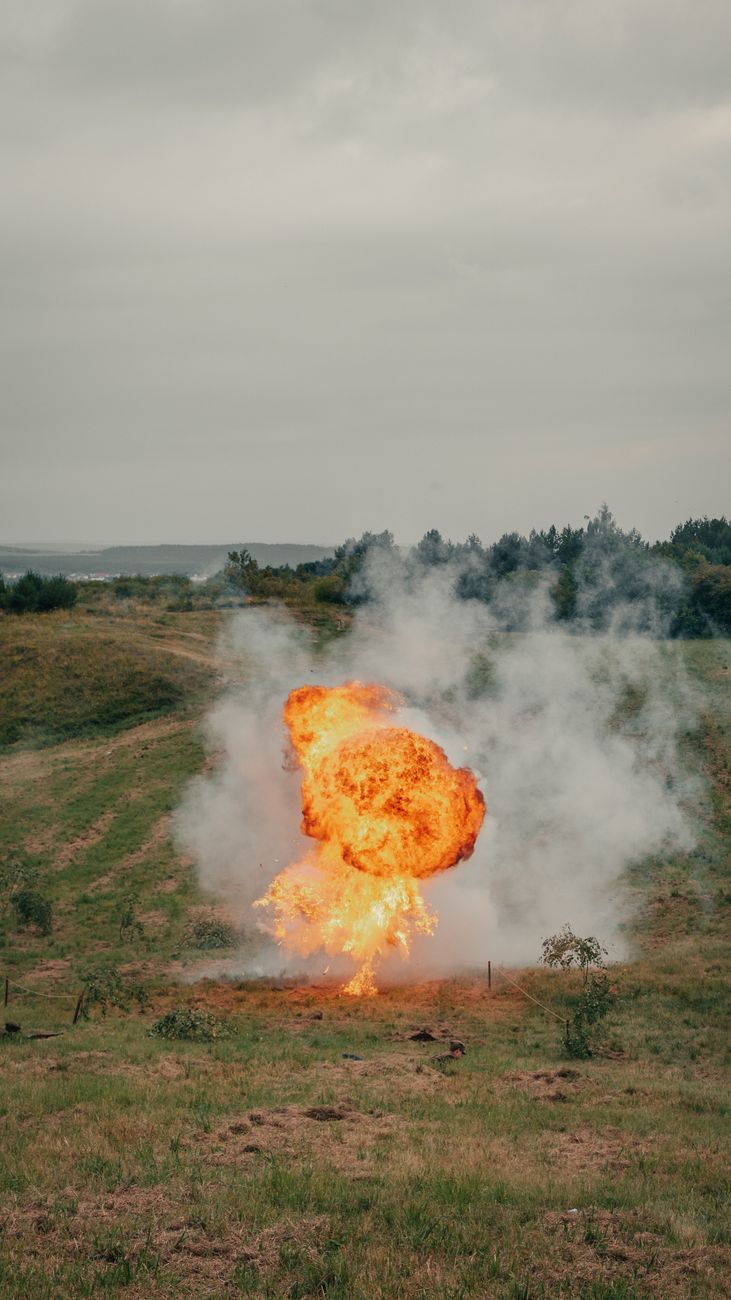
On the afternoon of 13 August 2026, a fire and subsequent explosion struck the KNDS Ammo Italy munitions plant at Colleferro, roughly 40–60 km southeast of Rome. The incident is a reminder — for anyone working with energetic materials, whether in manufacture, storage, or transport — of how quickly a contained process fire can escalate, and how much staffing and timing can matter to the outcome.
What happened
Shortly after 15:00 local time, a fire broke out in the powder-pressing department of the plant, formerly known as Simmel Difesa and now operated by KNDS Ammo Italy, a subsidiary of the Franco-German KNDS group. Firefighters and Carabinieri were already at the scene responding to the fire when a powerful secondary explosion occurred, audible for kilometres and visible as a large plume of smoke over the site.
No injuries were reported. The plant was running on reduced summer-holiday staffing at the time — around 24 workers, all of whom were accounted for and reached designated safe areas under existing evacuation protocols. Colleferro’s mayor, Giulio Calamita, noted that the outcome could have been far more serious had the incident occurred outside the holiday period, when staffing levels are higher.
Investigation
The Velletri prosecutor’s office has opened a file, with an industrial accident as the initial working hypothesis; the precise technical cause — whether equipment malfunction or process failure in the powder-pressing line — remains under examination. KNDS has stated it has launched its own internal investigation. Speculation about possible sabotage has circulated online, but authorities have not produced evidence supporting that theory.
Site context
KNDS Ammo Italy manufactures medium- and large-calibre ammunition for land and naval defence systems, together with solid propellants for aerospace and missile applications, and supplies 155 mm NATO-standard ammunition under European defence cooperation arrangements.
Why this matters beyond the headlines
For those of us working in dangerous goods compliance, incidents like Colleferro sit slightly outside our usual frame of reference — this was a manufacturing-site event governed by industrial (Seveso) safety law, not a transport incident under IMDG Code, 49 CFR, or ADR. But the underlying hazard class is the same one we classify and document every day: Class 1 explosives and their precursor energetic materials, whether in bulk propellant form during manufacture or packaged for carriage.
With that in mind, two general points seem worth carrying into DG practice:
- The line between “process” and “transport” risk is thinner than the regulatory silos suggest. The same powder that is UN-classified and packaged for shipment under IMDG Chapter 3.3 / Class 1 provisions is, upstream, being pressed and handled in bulk under a completely different regulatory regime. Anyone auditing supply chains for explosives-adjacent cargo benefits from understanding both ends.
- Staffing levels are a variable worth modelling. Whatever the eventual cause, the fact that reduced holiday-period presence coincided with a no-injury outcome is a useful data point for anyone thinking about workforce exposure scheduling at high-hazard sites — independent of what triggered the event itself.
We’ll follow up once the Velletri prosecutor’s office and KNDS publish findings on root cause.
Sources: Reuters, Bloomberg, Euronews, AP, Kyiv Independent, and Italian regional reporting, 13–14 August 2026.
Italian media have since reported that investigators are also examining a possible connection to an explosion three days earlier (10 August) at an ammunition facility operated by EMCO in Belitsa, Bulgaria — another supplier to Ukraine’s armed forces. This has fed public speculation about a possible sabotage or “hybrid attack,” a theory raised by some Italian politicians. Defence Minister Guido Crosetto and Mayor Calamita have both publicly urged caution on that theory, and no evidence of a deliberate act has been made public. KNDS has stated it is still unable to determine the cause or the exact sequence of events.
Both the accidental/internal-fault hypothesis and the sabotage hypothesis remain open lines of inquiry. Neither is confirmed, and this article does not endorse or assign likelihood to either.
Discover more from IMDG Code Compliance Centre
Subscribe to get the latest posts sent to your email.