


Our last article covered ISPM 15 — the treatment and marking of the wood packaging inside a container. This one moves up a level: what happens when the container itself has been fumigated for its sea voyage. The rules that follow depend entirely on one question asked at the load port — has the unit been ventilated before it comes aboard, or not? Get that distinction wrong and you’ve either over-documented a container that needed nothing, or sent a gas-filled box to sea without telling the master what’s inside it.
- What UN 3359 covers
- The core divide: ventilated vs. non-ventilated units
- The fumigation warning mark
- Documentation for non-ventilated units
- Shipboard handling of units in transit under fumigation
- The fumigants you’ll encounter
- Detecting an undeclared fumigated unit
- Common errors that cause real problems
- References
1. What UN 3359 covers
A fumigated cargo transport unit is exactly what it sounds like, a closed CTU (container) holding goods or materials that have been fumigated within the unit itself. This is a different regulatory event from ISPM 15: it doesn’t matter whether the cargo, the dunnage, or the packaging is wood at all. Any closed unit carrying a fumigant gas (applied to control pests in grain, timber, machinery packing, textiles, or anything else) falls under IMDG 5.5.2 once that gas is present.
The pests being targeted generally fall into two broad groups: stored-product pests (weevils, beetles, moths and similar insects that infest grain, pulses, dried foodstuffs and similar bulk commodities) and wood and packaging pests (wood-boring beetles and similar insects that infest pallets, dunnage, and timber cargo itself — the same pest category ISPM 15 is built around, just encountered here in the cargo rather than the packaging). Fumigation is chosen over surface treatments precisely because a gas can penetrate into grain kernels, timber, cracks and voids that a spray or dust never reaches — and because it’s applied to kill pests at every life stage present (eggs, larvae, pupae and adults), not just the visible adult insects. This matters operationally too: eggs and pupae are typically the most resistant life stages to a given fumigant, so the concentration and exposure time that a fumigation schedule specifies has to be enough to kill the hardest stage to eliminate, not just the easiest.
A few scope points worth being precise about:
- A fumigated CTU containing no other dangerous goods is not subject to any part of the IMDG Code other than Chapter 5.5, section 5.5.2 itself.
- If the unit also contains dangerous goods in addition to the fumigant, all the normal provisions for those goods (placarding, marking, documentation, segregation) apply on top of the 5.5.2 provisions, not instead of them.
- Only CTUs that can be closed so that gas escape is minimised may be used to transport cargo under fumigation.
- Fumigants must never be applied to the contents of a CTU once it is already loaded aboard the ship. Fumigation happens shoreside, before loading — not as an in-transit treatment initiated at sea.

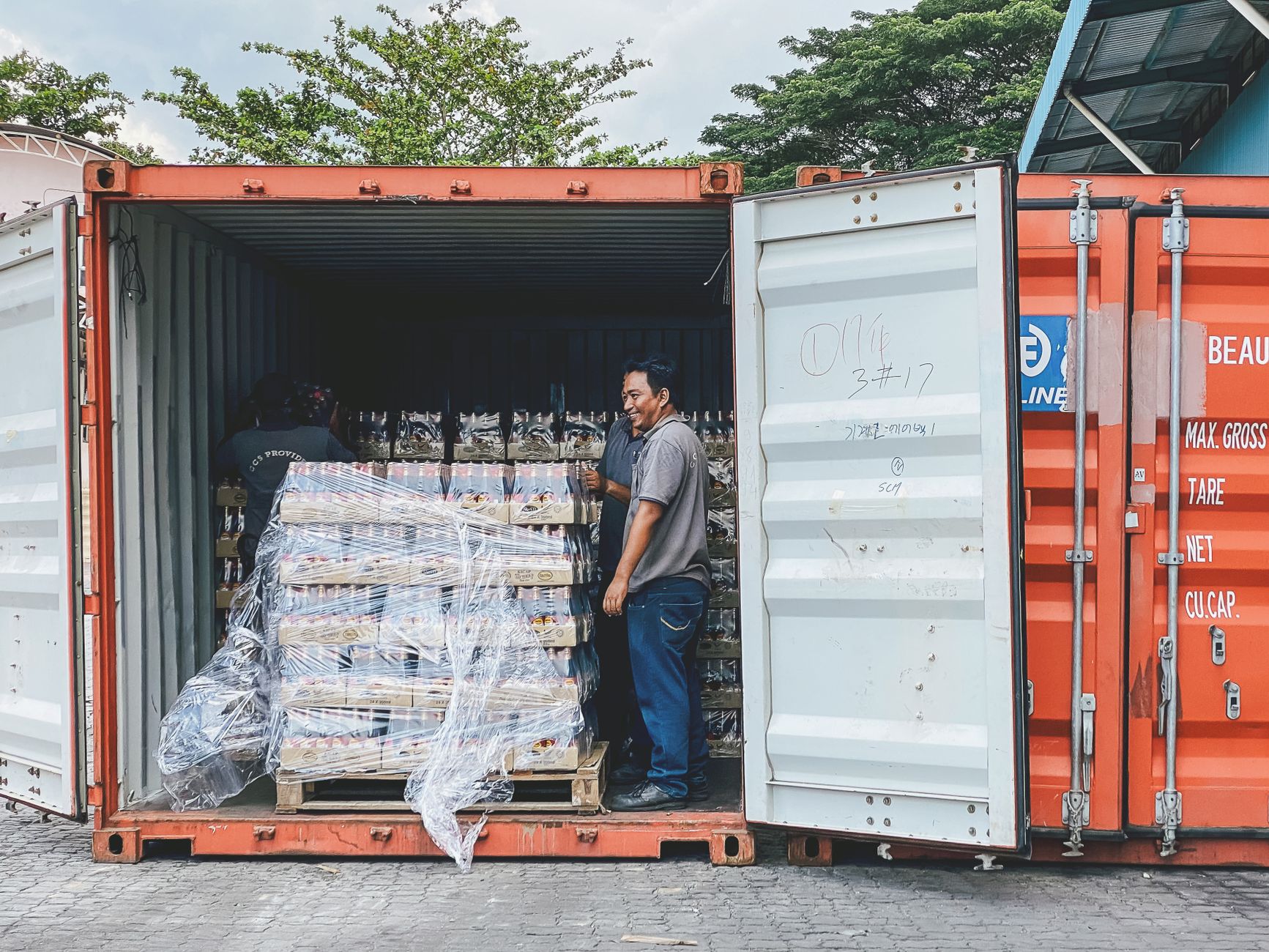
A closed cargo transport unit — once fumigated, it falls under IMDG 5.5.2 regardless of what the cargo inside actually is. Photo via Wikimedia Commons, licensed under CC BY-SA 3.0.
2. The core divide: ventilated vs. non-ventilated units
Everything downstream — marking, documentation, stowage — branches from a single shoreside decision: was the unit completely ventilated (by opening its doors or by mechanical ventilation) before it was loaded aboard the ship?
✓ Ventilated before loading
The unit has been opened up (or mechanically ventilated) and the fumigant gas allowed to escape completely, without unloading the cargo.
- The fumigation warning mark stays on the unit, but the date of ventilation is added to it.
- No transport document is required for UN 3359 purposes — the marked ventilation date substitutes for it.
- No special stowage category, gas-detection equipment, or ship-side precautions apply on account of fumigation.
- The mark itself is only removed once the unit has both been ventilated and the fumigated goods have been unloaded.
✗ Not ventilated before loading (“fumigation in transit”)
The unit still has an active fumigant atmosphere inside it when it comes aboard.
- Full UN 3359 treatment applies: proper shipping name, class 9, warning mark without a ventilation date.
- A transport document is mandatory, carrying the fumigant type, quantity, and date/time of application.
- The unit is entered on the special list/manifest/stowage plan with its stowage location.
- Ship-side precautions kick in — stowage location, gas-detection equipment, trained crew, master notification (see Section 5).
One further point the standard is careful about: 24 hours is normally sufficient between fumigant application and loading to reach a reasonably uniform gas concentration throughout the cargo, but the actual period is set by the competent authority and varies with fumigant type, quantity, commodity, and temperature. “24 hours” is a rule of thumb, not a fixed rule.
3. The fumigation warning mark
A fumigated CTU must carry the warning mark at each access point, positioned where anyone opening or entering the unit will see it easily. The mark’s specifications are exact:
- A rectangle, minimum 400 mm wide × 300 mm high, with an outer line at least 2 mm wide
- Black print on a white background, lettering not less than 25 mm high
Like all IMDG marks and placards on cargo transport units, the fumigation warning mark also has to meet the Code’s general marking-durability standard (Chapter 5.3): it must remain identifiable on a unit surviving at least three months’ immersion in the sea.
The mark stays on the unit until two conditions are both satisfied: the unit has been ventilated to remove harmful fumigant concentrations, and the fumigated goods have been unloaded.
4. Documentation for non-ventilated units
For units that have not been completely ventilated before transport, the accompanying documents must state:
- “UN 3359, fumigated cargo transport unit, 9” (or “…class 9”)
- The date and time of fumigation
- The type and amount of the fumigant used
The document can take any form, provided the information is easy to identify, legible and durable. IMDG 5.5.2.4.3 contains one further, mandatory requirement, and its entire text is worth quoting exactly since it’s easy to summarise loosely: “Instructions for disposal of any residual fumigant including fumigation devices (if used) shall be provided.” That’s the full provision — it doesn’t specify who must carry out the disposal, only that instructions for doing so must accompany the unit.
A document is not required at all once a unit has been completely ventilated and the ventilation date marked per Section 3 above — the mark itself carries the compliance information in that case, and the disposal-instructions requirement falls away with it, since there is no longer an active fumigant atmosphere or residue-generating device left inside to manage.
5. Shipboard handling of units in transit under fumigation

Containers awaiting loading — the ventilated/non-ventilated decision has to be made and acted on before this point, not after. Photo via Wikimedia Commons, licensed under CC BY-SA 4.0.
This is where MSC.1/Circ.1361/Rev.1 (2022) adds the operational detail that IMDG 5.5.2 itself doesn’t spell out. For a non-ventilated unit coming aboard:
- Pre-loading check — the unit should be checked for leaks before loading, and any leakage sealed. The master must be informed prior to loading.
- Stowage — UN 3359 carries stowage category B (on or under deck permitted) with stowage code SW2 assigned in column 16a of the Dangerous Goods List. SW2 is defined in IMDG Chapter 7.1 as “clear of living quarters,” which means the unit must be stowed a minimum distance of 3 m from accommodation, air intakes, machinery spaces and other enclosed work areas. On-deck stowage is preferred for non-ventilated units.
- If stowed under deck — the cargo space must have mechanical ventilation sufficient to keep fumigant concentration below the threshold limit for occupational exposure (found on the fumigant’s Safety Data Sheet), at a ventilation rate of at least two air changes per hour based on the empty cargo space. The ship must also carry gas-detection equipment suitable for the specific fumigant, with instructions for its use.
- If stowed on deck — the ship should still carry appropriate gas-detection equipment for the fumigant concerned.
- Trained representatives — at least one officer and one other crew member must receive appropriate training and be designated as the master’s trained representatives, responsible for safe conditions in occupied spaces and for briefing the crew before the fumigated unit is loaded.
- Onboard resources — the ship should carry at least four sets of appropriate respiratory protective equipment, the relevant Safety Data Sheet or fumigant manufacturer’s guidance, and emergency response information such as the current Medical First Aid Guide (MFAG).
- Arrival notification — the master should notify the destination country’s and any port-of-call’s appropriate authorities, generally at least 24 hours before arrival, that fumigation in transit is being carried out, stating the fumigant type, fumigation date, and which cargo spaces are involved.
None of this applies once a unit has been properly ventilated before loading — the entire shipboard framework above is triggered specifically by the “not ventilated” branch of the fork in Section 2.
6. The fumigants
Phosphine and methyl bromide are the two you’ll see most often on grain, timber and general dry-cargo shipments, but they aren’t the only fumigants in use for pest control more broadly. Chloropicrin, sulfuryl fluoride, hydrogen cyanide, formaldehyde, and several soil/pre-plant fumigants (1,3-dichloropropene, dazomet, methyl isocyanate, iodoform) also appear in general fumigation industry use — worth being aware of, though only phosphine and methyl bromide (and increasingly sulfuryl fluoride) are the ones MSC.1/Circ.1361/Rev.1 discusses in specific operational detail for CTU fumigation at sea.
| Fumigant | How it’s applied | Detection profile |
|---|---|---|
| Phosphine (from magnesium or aluminium phosphide) | Sachets, tablets or pressed plates that react with airborne moisture to release phosphine gas — requires little technical training to apply, and works over a longer exposure period | Slight “fishy garlic” odour; breaks down to a powdery grey residue (magnesium/aluminium hydroxide). Visual signs — sachets, tablets, residue — are often present inside the unit, though fumigant can migrate between cargo items and not be immediately visible. Moisture re-entering an opened unit can restart the reaction. |
| Methyl bromide | Supplied and applied as a gas — a relatively rapid process, normally complete in under 48 hours, but requires expertise to apply correctly | No reliable visual or odour signs — this is the more dangerous of the two from a detection standpoint. A unit fumigated with methyl bromide must be treated with gas-detection equipment and never assumed safe by sight or smell. |
| Sulfuryl fluoride | Applied as a compressed gas; increasingly used as a methyl bromide alternative | Colourless and odourless on its own — applicators typically introduce a small amount of chloropicrin alongside it purely as a warning agent, since sulfuryl fluoride itself gives no sensory warning. Heavier than air, so it pools in low, enclosed spaces. |
| Chloropicrin | Applied on its own as a soil/commodity fumigant, or deliberately added in small proportion to other fumigants as a warning agent | A powerful tear gas with an intensely irritating odour — the irritation itself is the detection mechanism, which is precisely why it’s blended into odourless fumigants like methyl bromide and sulfuryl fluoride. |
| Hydrogen cyanide | Generated from cyanide salts, or applied directly as gas | Classically described as having a faint bitter-almond odour, but a substantial proportion of people are genetically unable to smell it at all — odour cannot be relied on as a warning sign. |
| Formaldehyde | Applied as a gas or generated from paraformaldehyde | Pungent, sharply irritating odour to eyes and respiratory tract even at low concentration — rarely used today as a commodity fumigant compared with its historical use. |
| 1,3-Dichloropropene, dazomet, methyl isocyanate, iodoform | Primarily soil, nematode and pre-plant fumigants rather than commodity/container fumigants | Encountered far less often in sea container fumigation than in agricultural soil treatment — included here because they appear in the same IMO fumigant list, not because they’re common aboard ship. |
7. Detecting an undeclared or residual fumigant atmosphere
Before anyone opens or enters a fumigated (or supposedly ventilated) CTU, a risk assessment and gas test should be carried out. Three detection approaches are in common use, each with real limitations:
- Glass stain-tube equipment — simple, robust, and can be operated from outside the unit using a lance through the doorway; air is drawn through a reagent-impregnated tube that changes colour on contact with the target gas. Reliable, but tubes must be used within their expiry date and warmed above 0°C in sub-zero conditions.
- Electronic (photo-ionization) gas testing equipment — measures the target gas via UV-light ionization and is useful for preliminary screening, but a PID sensor cannot measure oxygen level on its own — that requires a separate electrochemical or galvanic oxygen sensor, often bundled into the same handheld multi-gas meter but functionally distinct from the PID cell. PID readings are also prone to false positives from cross-sensitivity to unrelated volatile substances, and are not accurate enough on their own for determining safe exposure levels.
- Personal monitors — available for phosphine (not for methyl bromide), useful as an ongoing audible warning device during unloading, but not suitable as the initial detection method, and an oxygen-level reading alone doesn’t confirm the atmosphere is fumigant-free.
Practical unloading guidance that follows from this: ventilate for as long as practicable before entry, unload front-to-back rather than “tunnelling” into the cargo to retrieve specific packages, and remember that gas can desorb from bagged cereals or cartons with large air spaces over many days — a unit “declared ventilated” some time ago can still present risk on reopening.
8. Common errors that cause real problems
References
- International Maritime Organization (IMO). IMDG Code, Chapter 5.5.2 — Special provisions applicable to fumigated cargo transport units (UN 3359). (Text also reproduced in full within the annex of MSC.1/Circ.1361/Rev.1, below.)
- International Maritime Organization (IMO). MSC.1/Circ.1361/Rev.1 (28 April 2022) — Revised Recommendations on the Safe Use of Pesticides in Ships Applicable to the Fumigation of Cargo Transport Units. https://www.register-iri.com/wp-content/uploads/MSC.1-Circ.1361-Rev.1.pdf (hosted copy via the Republic of the Marshall Islands Registry; the circular itself is an IMO document).
- UK Maritime and Coastguard Agency. MGN 700 (M) — Carriage of Cargoes: Guidance on the Safe Use of Pesticides in Ships. https://www.gov.uk/government/publications/mgn-700-m-carriage-of-cargoes-guidance-on-the-safe-use-of-pesticides-in-ships
Discover more from IMDG Code Compliance Centre
Subscribe to get the latest posts sent to your email.