


The industry spent years learning to ship intact electric vehicles and factory-fresh lithium-ion batteries correctly. Now a second, harder problem is arriving: EV battery packs coming back the other way, as waste.
Shipping intact electric vehicles used to mean one entry: UN 3171. That changed under Amendment 42-24, effective 1 January 2026, which moved lithium-ion, lithium-metal, and sodium-ion powered vehicles to the new UN 3556, UN 3557, and UN 3558 entries — UN 3171 no longer applies to them. Factory-fresh lithium-ion batteries, shipped under UN 3480, were never part of that change. What is changing now is the direction of the cargo: batteries are increasingly moving backward through the supply chain, as end-of-life waste rather than forward as new product.
Driven by surging EV adoption and tightening critical-mineral supply chains, the global battery circular economy is industrializing fast. For Shippers, freight forwarders, carriers, and port operators, this creates a genuine regulatory challenge: the logistics of spent, disassembled, modular, or potentially compromised battery components moving through the supply chain in reverse.
The Macro Landscape
First-wave EV battery packs are entering retirement. IEA’s Battery Circularity analysis estimates that around 1.2 million EV batteries could reach end-of-life by 2030 — a volume that current recycling infrastructure, historically fed mostly by factory production scrap, isn’t yet built to absorb at scale.
This shifts shipping lines from transport partner to critical waste-stream carrier — and most compliance frameworks in the industry were built around new-battery logistics, not this reverse flow.

Image: “Batteries for recycling” by Mauro Cateb, via Wikimedia Commons, licensed under CC BY-SA 3.0.
The Lifecycle Shift and the “Gray Area” Feedstock
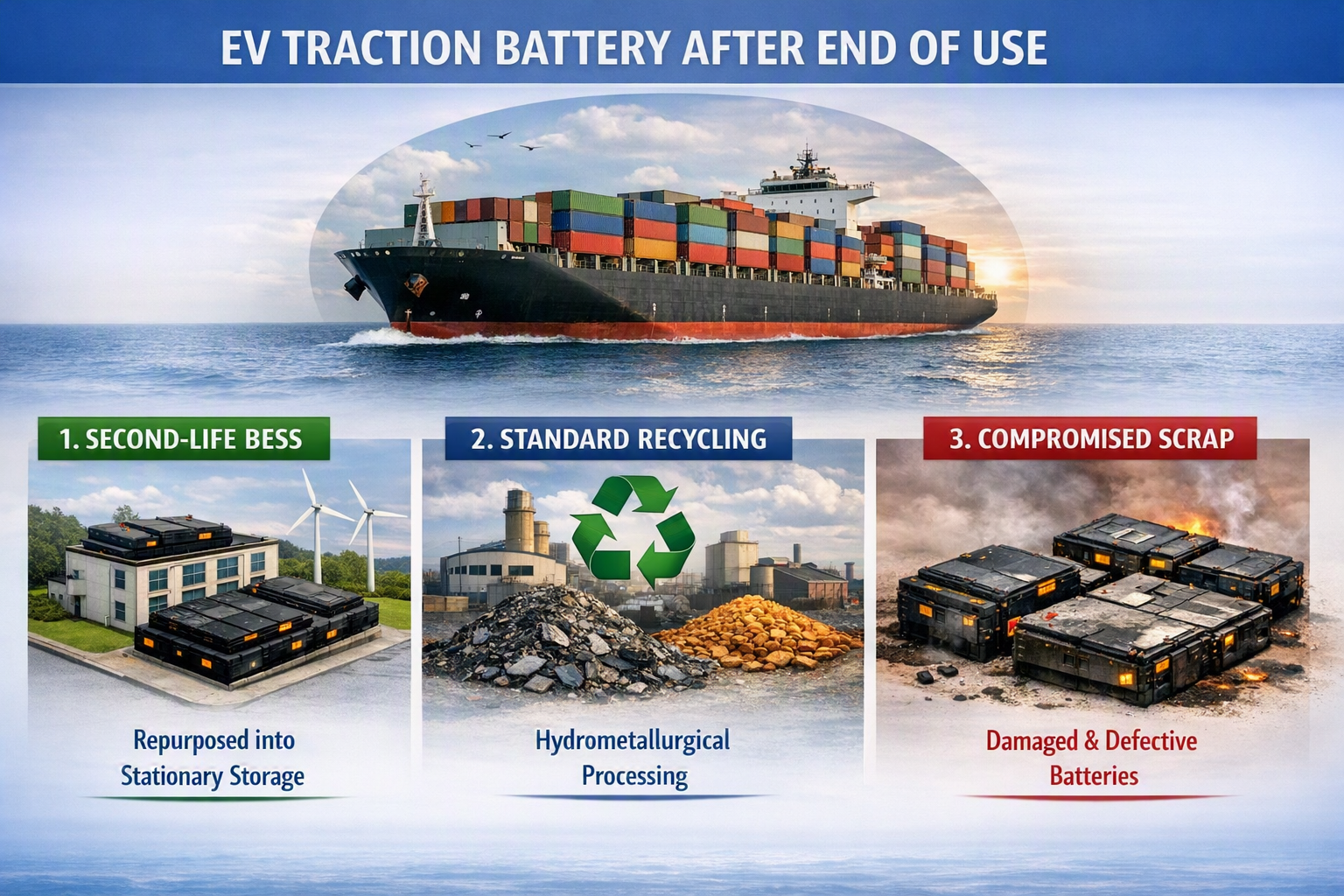
Unlike lead-acid batteries, which have well-established recycling pathways exceeding 95% recovery, lithium-ion and sodium-ion pathways remain operationally fragmented. Spent EV modules generally split into three lifecycle vectors after dismantling and diagnostic inspection:
1. Second-Life BESS
Repurposed into stationary storage systems.2. Standard Recycling
Routed to hydrometallurgical or similar processing.3. Compromised Scrap
Damaged, deformed, or defective — a materially different transport risk.This split creates a blind spot for forwarders: a crate of half-disassembled modules stripped from a retired chassis forces a determination on which of these three categories applies — and IMDG treats them very differently.
The Core Hazards of Reverse-Battery Logistics
1. Thermal Runaway and Propagation
A battery headed for disposal is rarely fully discharged. Micro-cracks in separators or degraded internal packaging from road use can trigger internal short circuits in transit. Once a cell passes its critical threshold — typically in the range of 150–180°C — it enters a self-perpetuating exothermic reaction, with cell temperatures capable of exceeding 1000°C. In a container packed tightly with spent modules, this can cascade into adjacent modules as thermal propagation.
2. Off-Gassing and Vapor Cloud Risk
Electrolyte breakdown under heat releases flammable and toxic gases — hydrogen, carbon monoxide, methane, and hydrogen fluoride among them. Scale-up destructive testing on second-life NMC modules (2.65–6.85 kWh) by Germany’s Bundesanstalt für Materialforschung und -prüfung (BAM) recorded jet flames up to 5 m long, fragments thrown more than 30 m, and mass loss of up to 82% during thermal runaway — one test escalated into an explosion of the released vent gas.[1] In a confined hold, that kind of accumulated gas release carries a real vapor cloud explosion risk.
3. Toxicity
Beyond fire risk, hydrogen fluoride release from a failing module poses acute respiratory and chemical-burn hazards to crew and terminal staff. In the same BAM test series, peak measured HF concentration reached 76 ppm — high enough that the study’s own toxicity screening against Acute Exposure Guideline Levels (AEGL) flagged carbon monoxide as an equally significant concern alongside HF.[1]
Navigating the IMDG Compliance Framework
The Misclassification Trap: Special Provision 188
Shippers may try to use SP 188 to spent modules instead of full Class 9 documentation, packaging, and placarding requirements. SP 188 carries strict thresholds:
- Lithium-ion cells: not exceeding 20 Wh
- Lithium-ion batteries/modules: not exceeding 100 Wh
Automotive battery modules almost universally exceed these thresholds. Shipping them under SP 188 is a genuine misdeclaration risk — they must be declared as fully regulated Class 9 dangerous goods under UN 3480.
The Real Fork: Standard vs. Compromised Scrap
Is the module damaged, deformed, leaking, or prone to off-gassing?
NO — SP 377
For disposal or recycling
- Standard Class 9 labeling
- Packed per P909
- Strong outer packaging with non-conductive short-circuit protection
YES — SP 376
Damaged or defective
- Rigid, UN-approved containment
- Packed per P908 or LP904
Route A: Disposal or Recycling (SP 377)
If modules are intact, stable, and show no physical distortion, they may move under SP 377.
- Packaging: P909 permits strong outer packaging (drums, crates) rather than full performance-tested packaging, provided short-circuit protection is maintained via non-conductive cushioning.
- Marking: Packages must carry LITHIUM BATTERIES FOR DISPOSAL or LITHIUM BATTERIES FOR RECYCLING (sodium-ion cells use the corresponding sodium-ion wording).
Route B: Damaged or Defective (SP 376)
If a module is stripped from an accident-damaged vehicle, shows swelling, leaking, or has recorded diagnostic faults, it falls under SP 376.

Image: “Coolpad S50 battery worn-out” by Solomon203, via Wikimedia Commons, licensed under CC BY-SA 3.0.
- Hazard assessment: The shipper must objectively evaluate whether the battery is prone to rapid thermal runaway, fire, or dangerous off-gassing under normal transport conditions.
- Packaging: If deemed critical, P908 or LP904 apply — UN-approved containment with thermal insulation, pressure relief, and fire-mitigation media such as vermiculite.
The Basel Convention Overlay: A Second Compliance Layer Hiding Behind IMDG
Getting the SP 376/SP 377 call right answers whether a shipment is safe to load. It doesn’t answer whether the cargo is legally allowed to cross a border at all — that’s a separate question, governed by the Basel Convention on the Control of Transboundary Movements of Hazardous Wastes and their Disposal, and it’s the layer most forwarders never check for battery waste.
Basel classifies waste batteries under three existing codes, none of which name lithium-ion chemistry specifically:
Lithium-ion falls into neither list by name. Whether a given shipment counts as B1090 (non-hazardous) or gets pushed into A1170 territory turns on the same fact pattern IMDG already asks you to establish: is the battery intact and functioning to spec, or is it damaged, leaking, deformed, or off-gassing?
- SP 377 territory (intact, stable): has a genuine claim to B1090 — waste batteries “conforming to a specification.” Whether that claim holds depends entirely on which competent authorities are involved. It’s a live, contested question: interpretations vary by Party, and at least one major bloc has moved decisively against it (see below).
- SP 376 territory (damaged/defective): almost by definition fails to “conform to a specification.” Combine that with an electrolyte that hydrolyzes to hydrogen fluoride and a cathode carrying cobalt and nickel compounds, and the cargo is likely to exhibit an Annex III hazard characteristic — flammability, toxicity, ecotoxicity — which pushes it toward A1170 (or the newer catch-all hazardous e-waste code, A1181, which captures e-waste exhibiting an Annex III hazard characteristic due to its Annex I constituents) rather than B1090.
Where PIC applies, two things follow: the exporting party needs written consent from the importing state and any transit states before the shipment departs, and a Movement Document — the Basel Convention’s tracking form — has to accompany the waste from the point of origin to final recycling or disposal. For EU-linked trade specifically, that Movement Document is no longer a paper form: since 21 May 2026, the EU’s Digital Waste Shipment System (DIWASS) is mandatory for all PIC notifications and generates the movement document electronically once every competent authority involved has consented — there’s no paper fallback.[2] Moving Basel-controlled waste without that consent isn’t a paperwork gap; under Basel Article 9 it’s illegal traffic, a materially more serious exposure than an IMDG packaging deficiency.
For India-based operations specifically, Basel obligations are given domestic effect through the Hazardous and Other Wastes (Management & Transboundary Movement) Rules, 2016 — import or export of scrap battery cargo needs clearance under those Rules, separately from customs/DGFT formalities and whatever IMDG documentation the shipment already carries. Worth noting for cross-border moves involving the US: the US is a Basel signatory but not a ratified Party, so US-linked shipments typically run under bilateral or OECD arrangements rather than the standard PIC procedure. And for anything moving through or into the EU, factor in DIWASS registration lead time — it’s a new system, and operators without an existing account should not assume same-week turnaround.
The practical takeaway for a forwarder handling an SP 376 shipment: whether a competent authority approval applies under IMDG and whether Basel’s Prior Informed Consent applies are two separate questions, from two different frameworks, and a booking that only checks the carrier’s acceptance criteria may still be exposed on both.
Best Practices for Maritime Logistics Professionals
- Enforce SDS verification. Never accept a commercial description of “scrap metal components” or “used auto parts” without cross-referencing the SDS and physical photos of the loaded cargo.
- Get SoC data — but attribute it correctly. A lower state of charge reduces the energy available to feed a thermal event, and requesting SoC data as part of cargo acceptance is good practice. But the 30% SoC ceiling is an ICAO/IATA air transport limit — IMDG does not prescribe a fixed sea-freight SoC percentage. Ocean carriers instead tend to apply qualitative, voyage-adapted risk assessments (CMA CGM’s approach is a good example) rather than a hard cut-off. Don’t present a specific percentage to a shipper as an IMDG requirement when it isn’t one.
- Implement physical inspection holds. Train warehouse personnel to spot chemical odors, terminal corrosion, or casing deformation before cargo is containerized and placarded.
- Check the Basel status, not just the IMDG entry. An SP 376 (damaged/defective) determination is a strong signal to check whether Prior Informed Consent is also required before the shipment is booked — don’t let the IMDG paperwork stand in for the Basel one.
The wave of end-of-life EV batteries is a genuine commercial opportunity for the industry — but it demands the same operational discipline applied to newly manufactured chemical payloads, not less. Getting the SP 376/SP 377 fork right, confirming whether a competent authority approval applies, and checking whether Basel’s Prior Informed Consent applies on top — that’s where the discipline actually lives.
[1] Tschirschwitz, R., Bernardy, C., Wagner, P., Rappsilber, T., Liebner, C., Hahn, S-K., & Krause, U. (2023). Harmful effects of lithium-ion battery thermal runaway: scale-up tests from cell to second-life modules. RSC Advances, 13, 20761. DOI: 10.1039/d3ra02881j. Open access.
[2] European Commission. Battery-related waste codes update set to boost circular economy (5 March 2025), amending Decision 2000/532/EC (List of Waste); European Commission, New Waste Shipment Regulation and DIWASS platform go live (21 May 2026), under Regulation (EU) 2024/1157.
Discover more from IMDG Code Compliance Centre
Subscribe to get the latest posts sent to your email.
As usual well worth the read excellent