


“The classification shall be made by the shipper/consignor or by the appropriate competent authority where specified in this Code.” (IMDG Code 2.0.0.1)
Classification answers two questions. Is this product dangerous goods under the IMDG Code? If it is, which entry in the Dangerous Goods List does it belong to?
The answer is the shipper’s to give. The competent authority classifies only where the Code says so, for example explosives of class 1. Everyone after the shipper works from that answer: the packer, the forwarder, the shipping line, the terminal and the ship. The packaging, marks and labels, the transport document, the stowage and segregation on board and the emergency response are all taken from the entry the shipper selected. If the classification is wrong, each of these is wrong too, and no one further down the chain can easily see it.
What classification gives you
| Item | What it tells the transport chain |
|---|---|
| UN number | The four-digit number of the entry in the Dangerous Goods List |
| Proper shipping name | The name of that entry, used on the package and the transport document |
| Class | The main hazard: flammable, toxic, corrosive and so on |
| Subsidiary hazard | Any further hazard the goods have |
| Packing group | The degree of danger: I high, II medium, III low. Not every class has one |
| Marine pollutant | Yes or no |
How to classify, step by step
| Step | What you do | IMDG Code |
|---|---|---|
| 1 | Collect the facts about the product: what it is made of, its physical and chemical properties, its toxicity and aquatic toxicity data, and test reports. | Chapters 2.1 to 2.10 |
| 2 | Set aside explosives (class 1), infectious substances (class 6.2) and radioactive material (class 7). They have their own procedures and are outside the flowchart. | 2.1.3, 2.6.3, 2.7 |
| 3 | Look for the product by name in the Dangerous Goods List. If it is listed, the List gives you the class, subsidiary hazard and packing group. | 2.0.1.5, 2.0.2.2 |
| 4 | If it is not listed by name, compare the product data with the criteria of each class and the marine pollutant criteria. A product that meets none of them is not subject to the Code. | 2.0.1.4 |
| 5 | For a mixture or solution made mainly of one listed substance, apply the mixture and solution rule and its exceptions. | 2.0.2.5 |
| 6 | If the product has more than one hazard, use the precedence of hazards table to find which is the class and which is the subsidiary hazard. | 2.0.1.6, 2.0.3 |
| 7 | Choose the generic or N.O.S. (“not otherwise specified”) entry that most appropriately describes the product. | 2.0.2.7 |
| 8 | Assign the packing group, where the class has one. With more than one hazard, the most stringent packing group applies. | 2.0.1.3, 2.0.3.1 |
| 9 | Read the special provisions shown against the entry in column 6, and decide whether the product is a marine pollutant. | Chapter 3.3, chapter 2.10 |
An example
A cleaning liquid is a mixture of solvents. It is not listed by name. Its flashpoint is 10 °C and its initial boiling point is 80 °C. It has no other hazard and is not a marine pollutant.
A liquid with a flashpoint of 60 °C or below is a flammable liquid of class 3 (2.3.1.2). A flashpoint below 23 °C with an initial boiling point above 35 °C gives packing group II (2.3.2.6). No more specific entry describes it, so the entry is UN 1993 FLAMMABLE LIQUID, N.O.S., class 3, packing group II. Special provision 274 against that entry requires the technical name to be added to the proper shipping name.
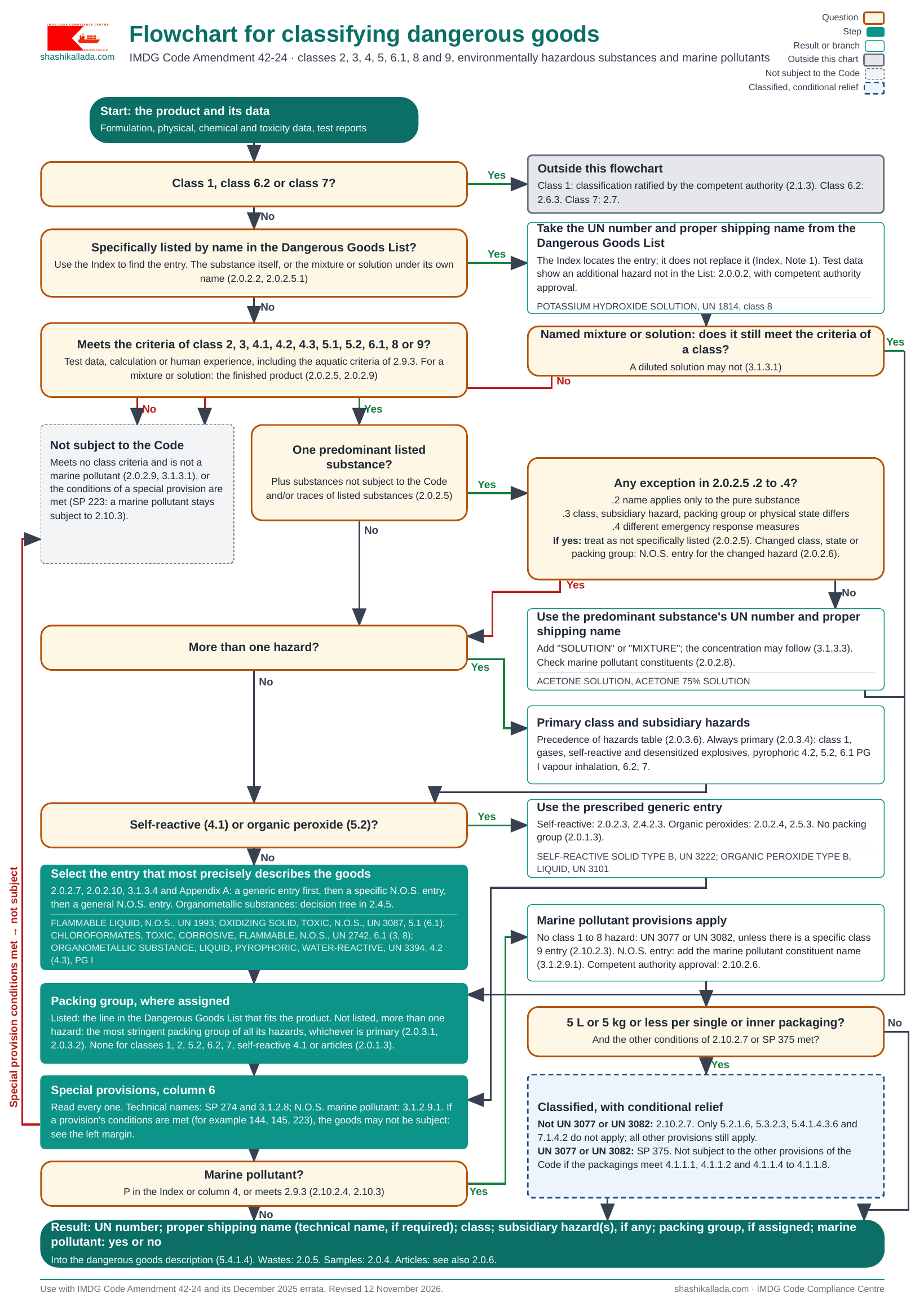
Flowchart for classifying dangerous goods
The flowchart sets out the same steps in full, with the paragraph of the Code to open at each one. It covers classes 2, 3, 4, 5, 6.1, 8 and 9, environmentally hazardous substances and marine pollutants.

Flowchart for classifying dangerous goods, IMDG Code Amendment 42-24. Open the PDF to read or print it at full size.
Those who classify dangerous goods and identify proper shipping names shall be trained before assuming that responsibility (IMDG Code 1.3.1.1, 1.3.1.2).
Based on IMDG Code Amendment 42-24. Revised 17 November 2026.
Discover more from IMDG Code Compliance Centre
Subscribe to get the latest posts sent to your email.