


On the evening of Friday 20 November 2026, a gas tanker caught fire at Sunbeth Filling Station near Awoyaya Bus Stop on the Lekki–Epe Expressway, Lagos. A second, much larger blast followed. Early accounts say the tanker was discharging at the station. Videos of the incident show a forecourt fire, a sudden fireball, and people filming from what looks like close range.
What a BLEVE is, and why the footage raises it
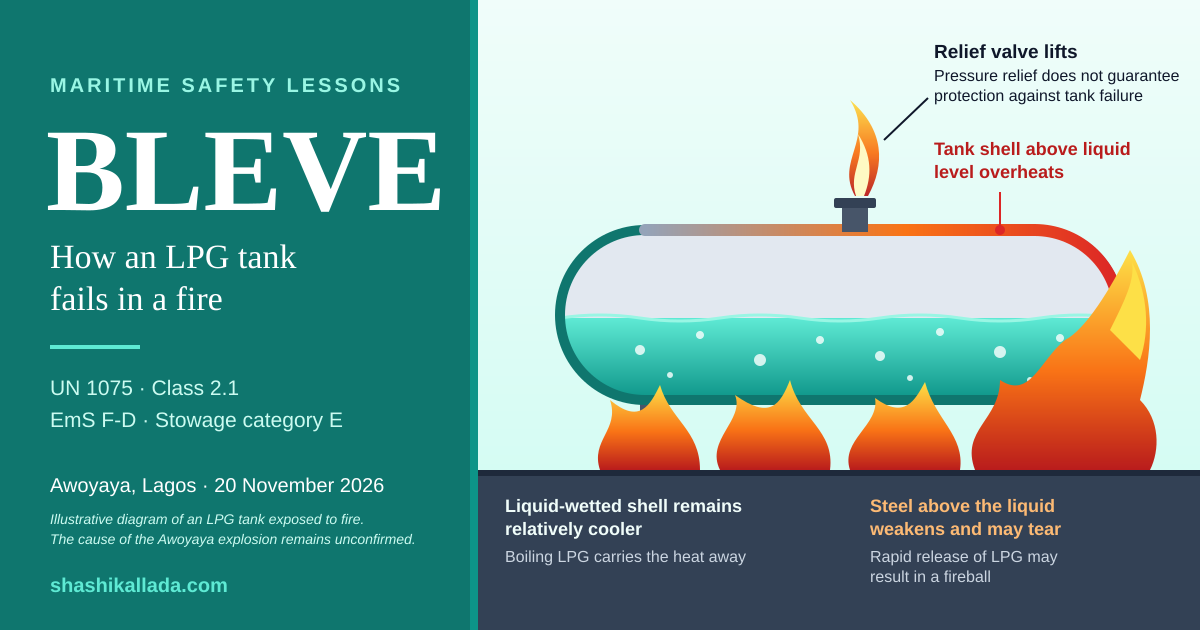
A sustained fire around a pressurised tank followed by a sudden fireball is the pattern associated with a boiling liquid expanding vapour explosion (BLEVE). Footage alone cannot establish that a BLEVE occurred at Awoyaya; that is for the investigation. The mechanism on a liquefied gas tank is:
- Fire heats the tank. The liquid boils, the pressure rises, and the relief valve lifts. You can hear it as a loud roar from the valve.
- The shell below the liquid level stays relatively cool, because the boiling liquid carries the heat away.
- The shell above the liquid, in the vapour space, is cooled only by vapour. Where flames hit it, the steel heats up and loses strength.
- The weakened shell tears. This can happen at or below the relief valve set pressure, so a working relief valve does not prevent it.
- The pressure drops at once. The superheated liquid flashes to vapour, the released gas ignites as a fireball, and tank fragments can be thrown a long distance.
How long this takes depends on where the flames hit the tank and how full it is. For a road tanker hit by a jet fire, it can be a matter of minutes, which is why approaching to film is so dangerous.
For a tank truck involved in fire, Emergency Response Guidebook Guide 115 (flammable gases) says to isolate for 1,600 m in all directions and to consider evacuating the same distance. It also tells responders to withdraw immediately if the sound from venting safety devices rises or the tank discolours. Guide 115 names LPG (UN 1075) specifically and refers responders to its BLEVE safety precautions.
Other tanker fires in Lagos this year
Neither of these incidents is a confirmed BLEVE, and no common cause is suggested. They show how often gas and fuel tankers are involved in fires on Lagos roads and forecourts.
On 21 March 2026, at 02:36, a speeding 20-tonne tipper truck ran into the back of a stationary 30-tonne gas tanker at Tera Ahmed Bus Stop, Sangotedo, on the same expressway. Two people died, and warehouses and roadside shops burned.
On 16 November 2026, four days before Awoyaya, a petrol tanker was discharging diesel at an NNPC station near Savannah Bus Stop, Command, Ejigbo. LASEMA’s preliminary findings were that the fire started from that tanker. It spread to the dispensing pumps and then to the school next door. No casualties were recorded.
Retail discharge brings together a pressurised hose and couplings, ignition sources on the forecourt, and the public a few metres away. The Awoyaya investigation will need to establish:
- where the release started: hose, coupling, valve or shell
- the condition and inspection status of the tank and its pressure relief devices
- whether bonding and earthing were connected before transfer began
- whether the emergency shut-off on the tanker and at the station was operated
- how far the discharge point was from the pumps and the road
Carriage of LPG by sea
Under 7.1.3.2, stowage category E allows on-deck or under-deck stowage on cargo ships and on passenger ships carrying not more than 25 passengers or 1 passenger per 3 m of overall length, whichever is greater. Other passenger ships are prohibited. Permission to stow under deck is not the same as every cargo space being suitable: the space must also be covered for Class 2.1 in the ship’s Document of Compliance.
BLEVE warnings in the EmS fire schedules
The BLEVE warning is not limited to the gas schedules. In the EmS Guide in force with Amendment 42-24 (MSC.1/Circ.1588/Rev.3), the same sentence appears in the general comments of four fire schedules. The wording is unchanged in Rev.4 (14 July 2026), issued for Amendment 43-26, which may be applied voluntarily from 1 January 2027 and becomes mandatory on 1 January 2028.
| Schedule | Covers | Warning and tank instruction |
|---|---|---|
| F-C | Non-flammable gases | Gases in closed tanks exposed to heat may explode suddenly by a BLEVE. Heated or ruptured cylinders may rocket. Exposed cargo: remove or jettison if practicable, otherwise cool with water for several hours. |
| F-D | Flammable gases (includes UN 1075) | Gases in closed tanks exposed to heat may explode suddenly by a BLEVE. Crew members should be aware of the explosion hazard. Keep tanks cool with copious quantities of water, and fight the fire from a protected position as far away as possible. Do not try to extinguish a gas flame: extinguishing a burning gas leak may lead to the formation of an explosive atmosphere. |
| F-E | Non-water-reactive flammable liquids | Cargoes in tanks exposed to heat may explode suddenly by a BLEVE. Keep tanks cool with copious quantities of water, and stop leakage or close an open valve if practicable. |
| F-G | Water-reactive substances | Cargoes in tanks exposed to heat may explode suddenly by a BLEVE. Use copious water to cool heated cargo nearby, but water in direct contact with the material will start or intensify burning. |
F-D also lists UN 1075, together with UN 1038, UN 1965, UN 1966, UN 1972, UN 3138, UN 3160, UN 3309 and UN 3312, as a special case: sudden or short-term events, such as explosions, may endanger the safety of the ship.
F-E is a reminder that a BLEVE is not only a gas-cargo event. A portable tank of flammable liquid heated in a fire can fail the same way once its contents are above their atmospheric boiling point. Under F-G, water that cools nearby cargo must be kept off the burning material itself.
On deck and under deck: how the response differs
The consequences of a tank failure may differ between on-deck and under-deck stowage. The table below assumes a hypothetical case with near-zero wind on deck. Actual outcomes depend on ship design, cargo arrangement, ventilation, weather and the incident itself, and the ship’s own emergency procedures govern the response.
| Factor | Under deck (closed cargo space) | On deck, wind near zero |
|---|---|---|
| Gas released before failure | LPG vapour is heavier than air and can collect in the lower parts of the space. How well ventilation removes it depends on the system and the amount released. | With little wind, vapour disperses slowly and can spread across hatch covers and between stacks, towards ventilation inlets and accommodation. |
| Confinement | A confined space adds the possibility of a vapour cloud explosion before any tank fails. Pressure from an explosion in the hold will act on the hatch covers and hold boundaries. | An unconfined cloud, if ignited, is more likely to burn as a flash fire. The BLEVE risk remains while fire acts on a tank’s vapour space. |
| Heat | Heat builds up in the space. A fixed gas system can suppress the fire, but it does not cool a tank shell that is already hot, so the hazard can continue after the flames are out. | Without wind to carry it away, the hot plume rises above the fire and the containers in the tiers above are exposed. |
| Crew response | Access to the tank is restricted once the space is closed. F-D: stop ventilation, close hatches, use the cargo space fixed fire-extinguishing system; if none is available, create water spray using copious quantities of water. | Boundary cooling with hoses is possible, from a protected position as far away as possible (F-D). The EmS Guide notes that at sea the master may alter course and speed to keep gases and vapours away from personnel, living quarters and ventilation inlets. |
Under F-D, a gas flame is not to be extinguished, because putting out a burning leak may lead to an explosive atmosphere. With little wind, released gas disperses slowly, so the instruction applies with particular force. Tanks are kept cool while the leak is dealt with.
Points for anyone shipping LPG in tanks
- A pressure relief device does not protect a tank shell that is being heated by fire above the liquid level.
- Before loading a T50 tank, check that its initial and periodic inspection and test dates on the plate (6.7.3.16.1) are within validity, and ask for the inspection records if there is any doubt. This decides whether the tank may be offered for transport at all.
- Under-deck stowage is a separate question: stowage category E, the Document of Compliance for the cargo space, and segregation from adjacent cargo all apply.
- Emergency plans should cover the cargo next to the tank as well as the tank itself, following the EmS schedules for both and the ship’s own procedures.
Members of the public who see a burning gas tanker should never approach it to take photographs or videos. Move well away at once and follow the instructions of emergency services.
Sources: Western Nigeria Publica, 20 Nov 2026 · LPG in Nigeria, 21 Nov 2026 · The Guardian Nigeria, Ejigbo station fire, 17 Nov 2026 · Premium Times, Sangotedo collision, 21 Mar 2026 · ERG 2024 guide summaries · IMO EmS Guide, MSC.1/Circ.1588/Rev.4 (14 July 2026)
Discover more from IMDG Code Compliance Centre
Subscribe to get the latest posts sent to your email.