


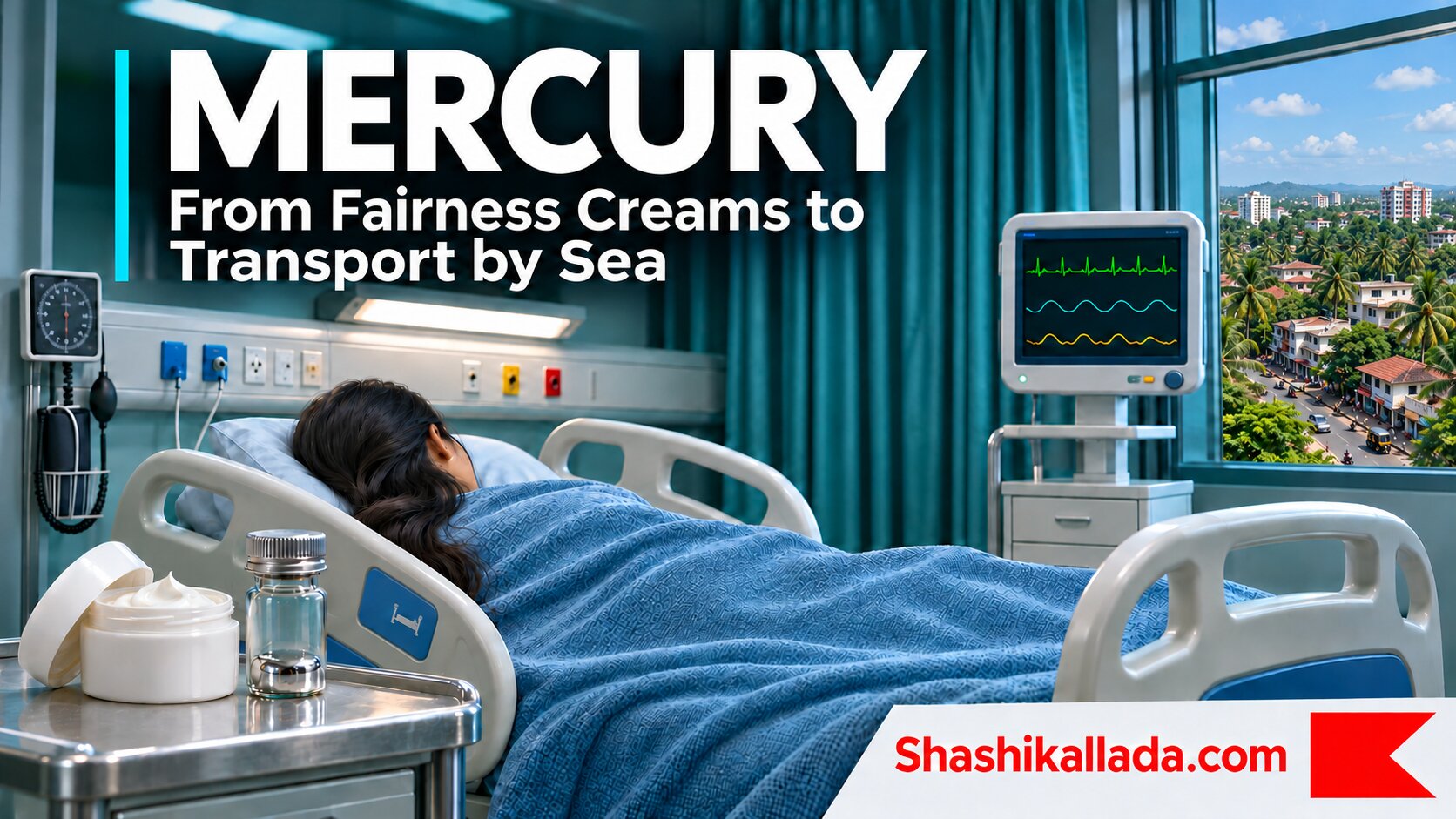
A fairness cream sold online and promoted by Instagram influencers contained 12,500 ppm of mercury, that is, 1.25% by mass. A teenager in Keralam used it for nearly a year. She now has membranous nephropathy, a kidney disorder that her treating doctor has linked to mercury poisoning from the cream.
The Cosmetics Rules, 2020 allow up to 70 ppm of mercury as a preservative in eye-area products and no more than 1 ppm, as an unintentional trace, in other cosmetics. Those limits came from a 2017 amendment (G.S.R. 56(E)) to the Drugs and Cosmetics Rules, 1945. The cream was more than 12,000 times over the limit for a face product.
A paper published in November 2026 in the International Journal of Environmental Research and Public Health pooled 2,090 skin-lightening product samples collected between 2009 and 2026 from 31 countries and 3 US localities. As reported by The News Minute, 66% contained mercury and 49% exceeded 1 ppm. The samples came from targeted surveillance by public health agencies and NGOs, which looks for suspect products, so these figures are not a measure of the whole market.
Mercury from a cream does not stay with the user. Health authorities have recorded poisoning in family members, including a toddler in California whose mother used a cream with 38,000 ppm of mercury.
How mercury harms the body
Mercury belongs with lead, cadmium and the metalloid arsenic among the toxic elements that have no known function in the human body. Mercury binds to sulphur-containing groups in proteins and enzymes and can affect several organ systems. How long it stays in the body depends on its chemical form, but daily application of a cream for a year means a steady, repeated dose.
WHO lists mercury among the ten chemicals or groups of chemicals of major public health concern. Different forms of mercury produce different patterns of exposure and toxicity:
| Form | Typical exposure | Main targets and effects |
|---|---|---|
| Elemental (metallic) mercury | Breathing vapour from spills, broken instruments, dental and industrial work, artisanal gold mining | Absorbed through the lungs. Nervous system: tremor, insomnia, memory loss, headaches, cognitive and motor dysfunction. Also lungs and kidneys. |
| Inorganic salts (e.g. mercuric chloride, ammoniated mercury) | Skin-lightening creams and soaps, some traditional preparations | Corrosive to skin, eyes and gut. Kidneys: effects range from protein in the urine to kidney failure. Membranous nephropathy is a recognised form. |
| Organic (methylmercury) | Eating fish and shellfish | Central nervous system. The unborn child is most at risk, because methylmercury crosses the placenta and affects brain development. |
In membranous nephropathy, immune deposits build up in the filtering walls of the kidney and thicken them. Protein leaks into the urine, which can turn it foamy, and fluid collects in the tissues. Swelling of the legs and face was among the symptoms reported in the Keralam case.
Mercury in Ayurvedic preparations
Rasa shastra is the tradition within Ayurveda that deliberately combines herbs with metals such as mercury, lead, iron and zinc, with minerals such as mica, and with gems. Its practitioners hold that these medicines are safe and therapeutic when properly prepared and administered.
In a 2008 JAMA study led by Robert Saper of Boston University, about one-fifth of Ayurvedic medicines bought online, made in both the US and India, contained detectable lead, mercury or arsenic. Rasa shastra products had a higher prevalence of metals than herbal-only ones: 40.6% against 17.1%. A doctor investigating unexplained kidney or nerve symptoms should ask about traditional medicines as well as cosmetics.
The Minamata Convention
The Convention is named after the Minamata disaster, which came to light in Minamata, Japan, in May 1956, after industrial wastewater had been discharged into Minamata Bay since the 1930s. It was adopted in Kumamoto on 10 October 2013 and entered into force on 16 August 2017.
India ratified it on 18 June 2018, and it entered into force for India on 16 September 2018. India’s ratification carries a declaration that amendments to the annexes enter into force for India only when India deposits its own instrument for each amendment.
Annex A, Part I lists mercury-added products whose manufacture, import and export are to be phased out. The original listing covered cosmetics with more than 1 ppm of mercury, including skin-lightening soaps and creams, with a 2020 phase-out date. At COP-5 the Parties removed the 1 ppm threshold, so no mercury may be added to cosmetics at all. That amendment entered into force on 25 April 2025 for all Parties except those with a declaration such as India’s; for India it applies only once India deposits its instrument for it. Eye-area cosmetics that use mercury as a preservative where no safe substitute exists remain excluded, and the Convention’s text states that cosmetics with trace contaminants of mercury are not covered. At 12,500 ppm, the mercury in the cream used in Keralam cannot be a trace contaminant.
Mercury under the IMDG Code
| UN No. | Proper shipping name | Class (sub. hazard), PG | Notes |
|---|---|---|---|
| UN 2809 | MERCURY | 8 (6.1), III | SP 365 (articles go to UN 3506); EmS F-A, S-B; SGG7 and SGG11; SG24 (away from SGG17 azides) |
| UN 3506 | MERCURY CONTAINED IN MANUFACTURED ARTICLES | 8 (6.1), no PG | SP 366: articles with not more than 1 kg of mercury are not subject to the Code; LQ 5 kg, E0; P003 with PP90; EmS F-A, S-B; Category B, SW2; SG24 |
| UN 2024 / UN 2025 | MERCURY COMPOUND, LIQUID, N.O.S. / MERCURY COMPOUND, SOLID, N.O.S. | 6.1, I, II or III | Marine pollutant (P); SGG7 and SGG11 |
| UN 2777, 2778, 3011, 3012 | MERCURY BASED PESTICIDE entries | 6.1; UN 2778 is 3 (6.1) and UN 3011 is 6.1 (3) | Flammable variants assigned by flashpoint |
Class 8 with a 6.1 subsidiary hazard
Mercury is poisonous, yet UN 2809 is Class 8 and toxicity appears only as the subsidiary hazard, while most mercury compounds are Class 6.1. A transport class does not rank the most serious health effect of a substance. Elemental mercury is in Class 8 because it corrodes metals, aluminium in particular. Where the protective oxide layer on aluminium has a defect, mercury gets through, forms an amalgam and stops the oxide layer from re-forming, so the attack continues into the metal. Humidity makes it worse, and the result is pitting and cracking. On mild steel the corrosion rate is low by comparison. The same property is the reason for restrictions on mercury in air transport, where airframes are aluminium.
Hovercraft and aluminium ships
Column 17 of the Dangerous Goods List deals with this directly. For UN 2809 it reads: “A silvery metallic element occurring in the liquid state at normal temperatures. Relative density: 13.546. Melting point: −39°C. Highly corrosive to aluminium. Toxic if swallowed, by skin contact or by inhalation. Special care should be taken if a leakage occurs during transport, especially when carried in breakable packages and in aluminium freight containers. Carriage should be prohibited in hovercraft and other ships constructed from aluminium.” For UN 3506 column 17 reads: “Mercury (UN 2809) is highly corrosive to aluminium. Carriage should be prohibited in hovercraft and other ships constructed with aluminium.”
Hovercraft and many fast ferries have aluminium alloy hulls and superstructures. A small spill from a broken flask or a damaged manometer can reach the bilge and start amalgamating the structure. The text sits in column 17 as a recommendation, not as a stowage code in column 16. Ship classification society rules apply the same thinking to coatings: IRClass rules for aluminium craft say paints containing lead, mercury or copper are not to be used.
Mercury in the sea
Once mercury reaches water, part of it is converted by microorganisms to methylmercury, depending on conditions in the water and sediment. Methylmercury bioaccumulates in fish and shellfish, and it biomagnifies: each step up the food chain carries a higher concentration than the step below. A predatory fish can hold far more than the water around it. This is how wastewater discharged into Minamata Bay reached the people who ate its fish. Cooking does not remove it.
Three instruments cover different routes by which mercury reaches the sea: carriage of packaged goods, deliberate dumping, and releases from land.
- MARPOL Annex III and the IMDG Code. UN 2809 MERCURY does not carry “P” in column 4 of the Dangerous Goods List. A blank column 4 does not settle the question: a substance that meets the criteria of chapter 2.10 is transported as a marine pollutant even when it is not identified in the List. Suppliers’ safety data sheets give mercury as very toxic to aquatic life with long-lasting effects, and many declare UN 2809 as a marine pollutant on that basis. UN 2024 and UN 2025, the n.o.s. entries for mercury compounds, do carry “P” in column 4. A marine pollutant needs the marine pollutant mark and must be declared as MARINE POLLUTANT on the dangerous goods declaration, except where 2.10.2.7 applies: single or inner packagings of not more than 5 L or 5 kg are not subject to the other marine pollutant provisions, provided the packagings meet the general provisions of 4.1.1.
- London Convention 1972. Mercury and mercury compounds are listed in Annex I, the substances whose dumping at sea is prohibited, subject to the Annex’s exceptions for wastes containing them only as trace contaminants.
- Minamata Convention. Beyond products, it controls releases of mercury to land and water from industrial sources and requires environmentally sound management of mercury waste.
For shippers of laboratory and industrial instruments: articles containing more than 1 kg of mercury go under UN 3506; articles with not more than 1 kg are taken out of the Code by SP 366, which says nothing about whether they are safe. Liquid mercury in flasks goes under UN 2809. A mercury-containing cream is not UN 2809; as a mixture it has to be classified on its own properties. Before booking either on a fast ferry or any aluminium-hulled craft, raise the column 17 recommendation with the operator, and avoid aluminium freight containers for flasks.
Sources: The News Minute, 22 Nov 2026 · Mercury in Skin Lightening Products: Seventeen Years of U.S. and Global Data, IJERPH 2026 · California Department of Public Health, health alert, 2014 · Deccan Herald, 21 Nov 2026 · WHO fact sheet: Mercury and health · Saper et al., JAMA 2008;300(8):915–923 · Minamata Convention: history · Minamata Convention: mercury in cosmetics · UN depositary notification C.N.296.2018 (India ratification) · UN depositary notification C.N.187.2025 (COP-5 amendments in force) · IMO: London Convention · BAM DGG-Info, UN 3506, IMDG 42-24 · IMDG Code Amendment 42-24, Dangerous Goods List
Discover more from IMDG Code Compliance Centre
Subscribe to get the latest posts sent to your email.