


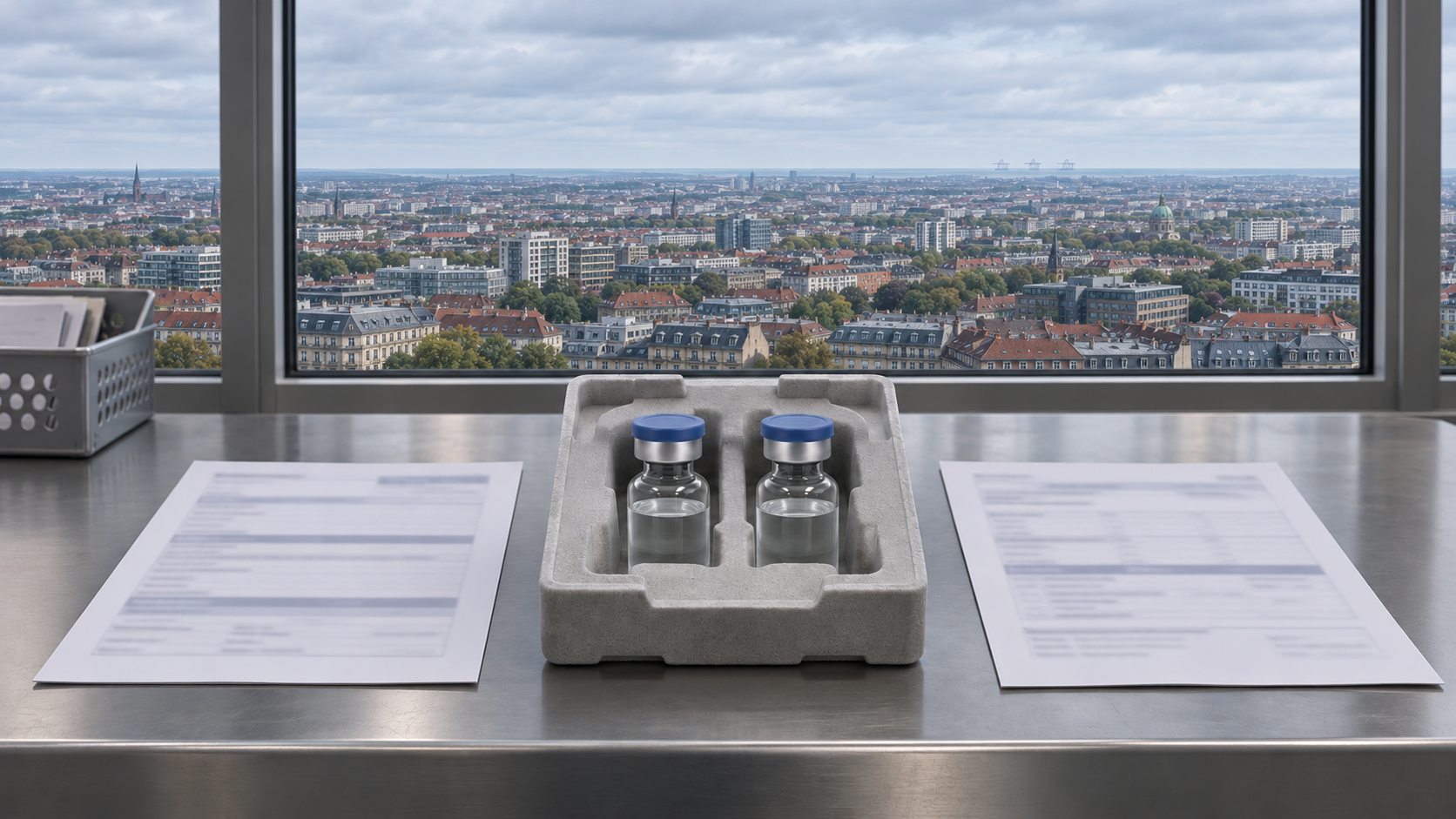
On 30 September 2026, Tennessee’s attempt to execute Christa Pike with pentobarbital failed, and she survived (HPPR). Her lawyers say they believe problems with the IV lines sent the drug into tissue instead of her bloodstream (Fox11/AP). On 12 November, 43 days after the Pike attempt, Texas executed John Allen Rubio in Huntsville with pentobarbital (KBTX/AP).
Pentobarbital moved into US execution protocols as supplies of sodium thiopental ran out. Hospira, the last US maker, stopped producing thiopental in 2011 (Pharmaceutical Technology), and the UK and then the EU put export controls on it and other barbiturate anaesthetics. In the EU those controls now sit in Article 16 and Annex IV of Regulation (EU) 2019/125. The entry covers short- and intermediate-acting barbiturate anaesthetic agents, including but not limited to amobarbital, pentobarbital, secobarbital and thiopental and their sodium salts (Annex IV; Regulation 1352/2011).
These same barbiturates are traded legally as human and veterinary medicines. Exporting them from the EU can require an authorisation under trade law, and carrying them by sea requires classification and declaration under the IMDG Code. Neither file establishes that the other is in order.
How the export controls built up, 2010 to 2019
The first control came out of a UK court challenge. In October 2010, claimants sought judicial review of the Business Secretary’s refusal to use the Export Control Act 2002 to stop sodium thiopental going from Archimedes, a UK company, to the United States (R (Zagorski and Baze) v SoS BIS [2010] EWHC 3110 (Admin)).
| Date | Instrument | What it did |
|---|---|---|
| Nov 2010 | UK SI 2010/2843 | Licence needed to export medicines containing thiopental sodium to the USA |
| 2011 | UK SI 2011/1127 | Revoked and replaced SI 2010/2843. Covered human or veterinary medicines in injectable form containing thiopental sodium, pancuronium bromide, potassium chloride concentrate or sodium pentobarbital, where the US was the destination or the known final destination. Ceased on 13 April 2012 |
| 20 Dec 2011 | Commission Implementing Regulation (EU) No 1352/2011 | Added short- and intermediate-acting barbiturate anaesthetics to Annex III of Regulation (EC) No 1236/2005; in force on publication in the Official Journal |
| 16 Jan 2019 | Regulation (EU) 2019/125 | Codified text; the anaesthetics now sit in Annex IV, with a Union General Export Authorisation in Annex V |
The EU chose an authorisation regime, not a full export ban on thiopental and the other barbiturates (World Coalition). Licensed trade carries on. Member States reported 292 export authorisations under the regulation in 2017 and 231 in 2018, across all controlled goods. The Commission’s product tables for 2017 show barbiturate exports authorised for medical use, hospitals, wholesalers and the pharmaceutical industry (Commission report, Annexes 1 and 2).
Recital 2 of Regulation 1352/2011 gives the reason: medicines exported to third countries had been diverted and used for capital punishment by lethal injection, which the Union opposes (1352/2011).
What changed on the US side
The European controls were one factor in a wider supply problem. Hospira stopped making sodium thiopental in 2011 (Pharmaceutical Technology). Newsweek reported that this left virtually all death rows without a steady supplier (Newsweek).
- Substitution. Oklahoma first used pentobarbital in December 2010, a year before the EU measure (Glossip v. Gross). Ohio and Texas followed (NBC News). In July 2019 the US Department of Justice adopted a single-drug pentobarbital protocol for federal executions (Euronews).
- Compounding. In 2025 the Death Penalty Information Center counted at least ten states that had used or intended to use compounding pharmacies for execution drugs (Indiana Capital Chronicle via Yahoo).
- Other sourcing. Pharmaceutical Technology reported that some states sought supplies from overseas manufacturers outside regulated channels and tried untested drug combinations (Pharmaceutical Technology).
The cost is visible in state records. On 26 October 2026, DPI reported two Tennessee Department of Correction payments since January 2023, of $525,000 and $650,000, totalling $1,175,000 (DPI).
Texas uses a single dose of pentobarbital (Fox11/AP) and has carried out more than 600 executions since 1982 (WSWS). In November 2022 Stephen Barbee was pronounced dead nearly an hour and a half after being strapped to the gurney. The prison said placing his IV lines took longer because he could not extend his arms (Texas Tribune; UPI).
Export authorisation and DG classification answer different questions
An Annex IV listing says nothing about how a product is carried. Regulation 2019/125 asks what the goods could be used for and who will use them. The IMDG Code asks what hazard the goods present in transport. One consignment can fall under either regime, both, or neither.
| Trade control (Reg. (EU) 2019/125) | DG transport (IMDG Code 42-24) | |
|---|---|---|
| Question asked | Could the goods be used for capital punishment or torture, and what is the end use? | What physical or health hazard do the goods present in transport? |
| Identified by | Legal description in the annex, with CAS number and CN code | UN number, proper shipping name, class, packing group |
| Who decides | Competent authority of the Member State where the exporter is resident or established | Consignor, classifying under Part 2 |
| Document | Export authorisation, presented at customs | Dangerous goods declaration (5.4.1) |
| What it does not establish | Transport classification | Export authorisation |
The practical point is the last row. A DGD does not show that a shipment is licensed, and a licence does not show that the shipment is correctly classified. Keeping both decisions linked to the same shipment record is good internal practice.
How the IMDG Code treats medicines
Under Amendment 42-24, mandatory from 1 January 2026, a medicine is classified on the hazards of the formulation offered for transport, not on its active substance alone. Where a formulation meets the criteria and no more specific entry applies, the Code has generic medicine entries:
| UN No. | Proper shipping name | Class (subsidiary hazard) | PG | Special provisions to check |
|---|---|---|---|---|
| UN 1851 | MEDICINE, LIQUID, TOXIC, N.O.S. | 6.1 | II, III | 221 |
| UN 3248 | MEDICINE, LIQUID, FLAMMABLE, TOXIC, N.O.S. | 3 (6.1) | II, III | 220, 221 |
| UN 3249 | MEDICINE, SOLID, TOXIC, N.O.S. | 6.1 | II, III | 221 |
UN 3248 is a Class 3 entry with a 6.1 subsidiary hazard; the other two are Class 6.1. SP 221 bars packing group I from all three. A formulation that falls in PG I goes under the most specific entry that fits its form and hazards, chosen by the precedence rules in Part 2. SP 220 on UN 3248 requires the technical name of the flammable liquid component only to be shown in parentheses immediately following the proper shipping name.
A medicine that meets none of the class criteria is not dangerous goods for transport. An active pharmaceutical ingredient shipped in bulk to a formulator is classified on its own data, separately from the finished product.
Technical names on generic and n.o.s. entries
Under 3.1.2.8.1, a generic or “not otherwise specified” proper shipping name assigned SP 274 or SP 318 in column 6 of the Dangerous Goods List is supplemented with the technical or chemical group name. That name goes in brackets immediately following the proper shipping name. A modifier such as “contains” or “containing”, a qualifying word such as “mixture” or “solution”, and the percentage of the technical constituent may also be used. The Code’s own example is UN 1993 Flammable liquid, n.o.s. (contains xylene and benzene), 3, PG II.
For medicines this works out as follows:
- UN 1851 and UN 3249 carry neither SP 274 nor SP 318, so no technical name is required.
- UN 3248 carries SP 220: the technical name of the flammable liquid component only is shown in parentheses immediately following the proper shipping name.
- UN 2810, UN 2811 and other generic Class 6.1 entries carry SP 274, so a formulation shipped under them is declared with the technical name in brackets after the proper shipping name.
Checks before releasing a pharmaceutical export from the EU
- Check the product against Annexes II, III and IV of Regulation (EU) 2019/125, using the legal description in the annex together with the CAS number and CN code. The Annex IV entry lists the agents under CN codes ex 2933 53 90 and ex 2933 59 95, and products under ex 3003 90 00, ex 3004 90 00 and ex 3824 90 96. Its note extends the control to products containing one of the listed agents.
- Apply the rule for the annex concerned. Annex II goods are prohibited from export, with narrow exceptions. Annex III and IV goods need an authorisation from the competent authority of the Member State where the exporter is resident or established. For Annex IV goods, check whether the Union General Export Authorisation in Annex V applies, including all of its conditions.
- Classify the formulation offered for transport under Part 2 of IMDG Code Amendment 42-24 and choose the most specific entry.
- Check the special provisions on that entry: SP 221 (no PG I on UN 1851, 3248 or 3249), SP 220 on UN 3248, and SP 274 or 318 for technical names (3.1.2.8.1).
- Link the export authorisation decision and the DGD to the same shipment record. Neither one establishes the other.
Sources
- Regulation (EU) 2019/125, with Annex IV
- Commission Implementing Regulation (EU) No 1352/2011
- UK SI 2010/2843, Explanatory Note
- UK SI 2011/1127
- R (Zagorski and Baze) v SoS BIS [2010] EWHC 3110 (Admin)
- European Commission report on export authorisations, 2017–2018
- IMO resolution MSC.556(108), IMDG Code Amendment 42-24
- Glossip v. Gross, 576 U.S. 863 (2015)
- DPI: Tennessee lethal injection drug spending, 26 October 2026
- Pharmaceutical Technology: Lethal injection – can pharma kill the death penalty?
- Euronews: US federal pentobarbital protocol, July 2019
- KBTX/AP: Texas executes John Allen Rubio
- Texas Tribune: Stephen Barbee execution
Discover more from IMDG Code Compliance Centre
Subscribe to get the latest posts sent to your email.